
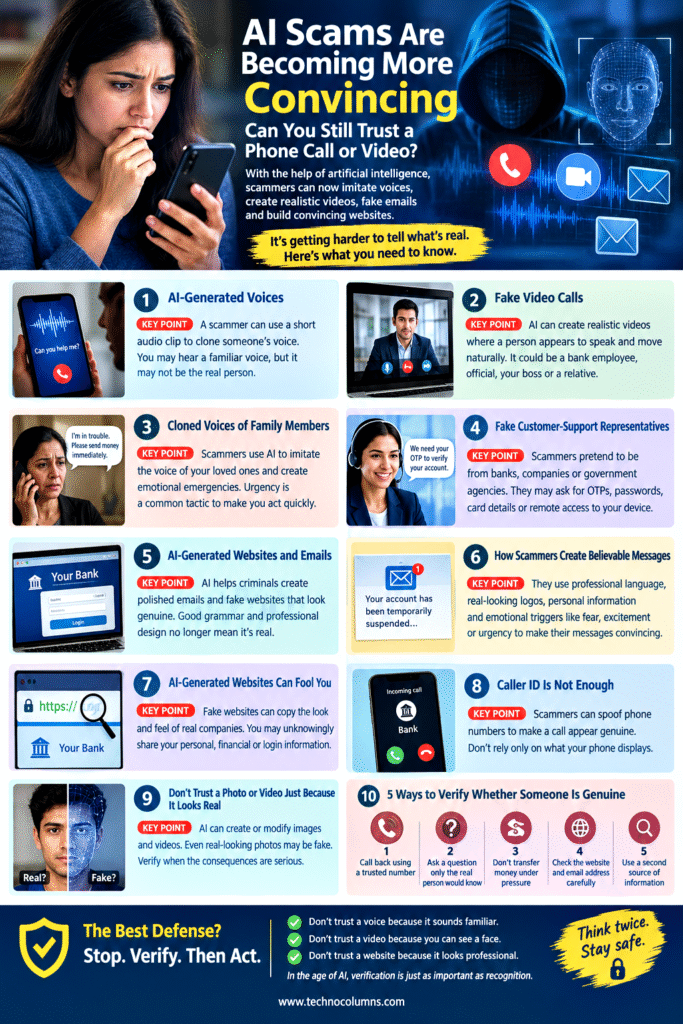
AI Scams Are Getting Smarter
Technology has made communication easier than ever. We can now speak to someone on the other side of the world, have video conversations, send instant messages, and even use artificial intelligence to create realistic images, voices and videos.
But the same technology can also be misused.
Artificial intelligence is making some scams much more convincing because criminals can use AI to imitate voices, create realistic videos, produce convincing emails and build fake websites. The FBI has warned that AI-generated videos and other AI techniques are being used in impersonation schemes, while the FTC reported that consumers lost $3.5 billion to imposter scams in 2025.
This raises an important question: Can we still trust what we hear and see online?
Here are some important things everyone should know.
1. AI Can Now Clone a Person’s Voice
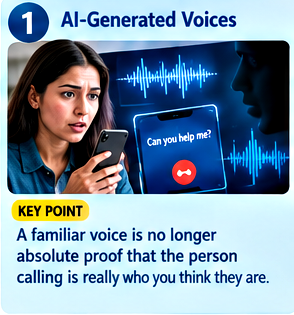
One of the most worrying developments is AI voice cloning.
A scammer may obtain a short recording of someone’s voice from social media, YouTube, a video or another publicly available source. AI tools can potentially use such material to create synthetic speech that resembles the person’s voice.
Imagine receiving a phone call that sounds exactly like your son, daughter, friend or relative.
The caller might say:
“I have an emergency. I need money immediately.”
The voice may sound familiar enough to make you react emotionally before you have time to think.
Key point: A familiar voice is no longer absolute proof that the person calling is really who you think they are.
The FBI specifically warns that AI-generated voices can be used to masquerade as known contacts.
2. Fake Video Calls Can Make a Scam Look Even More Real
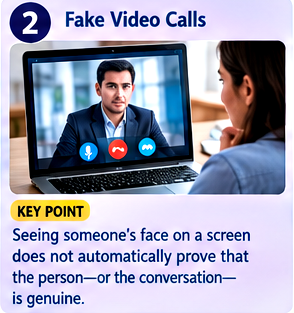
A voice can be convincing, but seeing someone’s face on a video call can make the deception even stronger.
AI-generated video can be used to create a person who appears to speak and move in a believable way. The FBI reported in 2026 that scammers have used AI-generated video and video chats to impersonate officials and other people.
For example, someone could appear on a video call claiming to be:
- A bank employee
- A government official
- A company executive
- A police officer
- A relative
- A customer-support representative
The presence of a face can create a powerful feeling of authenticity.
Key point: Seeing someone’s face on a screen does not automatically prove that the person—or the conversation—is genuine.
3. A Scammer Could Pretend to Be a Family Member
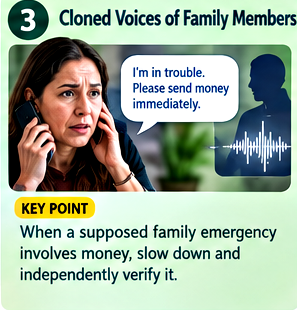
Family impersonation scams are particularly dangerous because they exploit emotions.
A scammer might call using a cloned voice and say:
“I lost my phone.”
“I’m in trouble.”
“Please don’t tell anyone.”
“I need money urgently.”
The scam becomes more believable if the criminal already knows the person’s name, relatives or other publicly available information.
The natural reaction may be to help immediately.
But urgency is exactly what can prevent us from thinking carefully.
Instead of immediately transferring money, contact the family member using a phone number you already know—not the number provided by the caller.
Key point: When a supposed family emergency involves money, slow down and independently verify it.
4. Fake Customer-Support Representatives Can Look Genuine
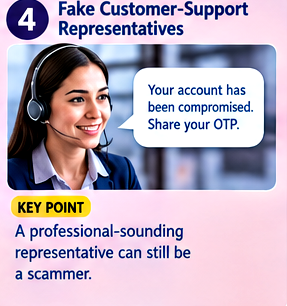
Many people trust customer-support representatives because they believe they are dealing with a legitimate company.
Scammers can exploit this trust.
You might receive a call claiming:
- “There is suspicious activity on your account.”
- “Your bank account has been compromised.”
- “Your computer has a virus.”
- “Your parcel cannot be delivered.”
- “We need to verify your identity.”
The scammer may then ask for an OTP, password, card information, remote computer access or a payment.
AI can make conversations and messages appear more professional and convincing.
Key point: A professional-sounding representative can still be a scammer.
When someone contacts you unexpectedly, independently find the company’s official contact information and contact them yourself.
5. AI Can Help Create Convincing Emails and Messages
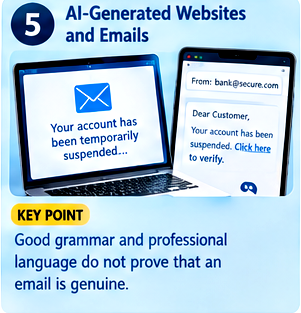
Poor spelling and strange grammar were once common warning signs of scams.
AI is changing that.
Generative AI can help criminals produce polished messages with convincing language. The FBI has warned that generative AI can make fraudulent content more believable and remove some of the obvious mistakes that might otherwise expose a scam.
A fraudulent email might therefore look like a genuine communication from:
- Your bank
- An online shopping company
- Your employer
- A government organization
- A delivery company
- A social-media platform
Key point: Good grammar and professional-looking language do not prove that an email is genuine.
Always check the sender address and destination website carefully.
6. AI-Generated Websites Can Fool Even Careful Users
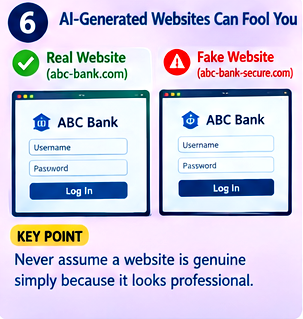
A scam doesn’t necessarily require a fake phone call.
A criminal can also create a website that looks remarkably similar to a legitimate one.
For example, a fake website might copy:
- The company’s logo
- Colours
- Page layout
- Login screen
- Customer-support information
- Government branding
The FBI has recently warned about spoofed websites being used in impersonation scams.
A victim may enter their name, phone number, password or financial information without realizing that the website is fraudulent.
Key point: Never assume a website is genuine simply because it looks professional.
Check the exact web address and, for important services, navigate to the organization’s website yourself rather than clicking an unexpected link.
7. Scammers Use Urgency to Stop You From Thinking
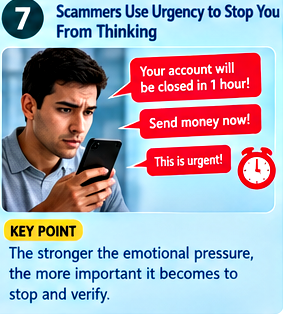
Technology isn’t the only weapon scammers use.
Psychology is equally important.
A scammer may create a situation involving:
- Fear
- Panic
- Excitement
- Anger
- A financial opportunity
- A supposed emergency
- A threat of arrest
- A limited-time offer
When people become emotional, they may act before verifying the information.
The FBI specifically advises people to be cautious when online content is designed to provoke strong emotions and to take time to verify surprising information.
Key point: The stronger the emotional pressure, the more important it becomes to stop and verify.
8. Caller ID Is Not Enough to Prove Who Is Calling
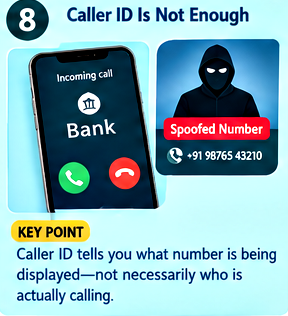
Many people assume that if their phone displays a familiar number or organization name, the call must be legitimate.
That assumption can be dangerous.
Scammers can use caller-ID spoofing to make a call appear to come from another number. The FBI has specifically warned about spoofed phone numbers being used in impersonation schemes.
Therefore, don’t rely solely on:
“The number looks familiar.”
Instead, verify the caller through another trusted channel.
Key point: Caller ID tells you what number is being displayed—not necessarily who is actually calling.
9. Do Not Trust a Video or Photograph Just Because It Looks Real
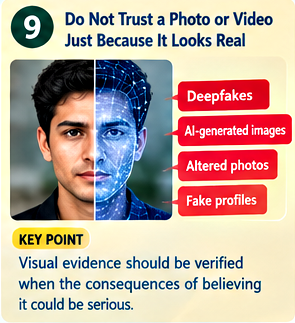
AI-generated images and videos can make fake information appear authentic.
A scammer might use:
- A real person’s photograph
- An altered photograph
- An AI-generated face
- A deepfake video
- A fake identity document
- A fabricated social-media profile
The FBI advises people to examine unusual facial features, movements, accessories, shadows and other inconsistencies—but also warns that AI-generated content can be difficult to identify reliably.
Key point: Visual evidence should be verified when the consequences of believing it could be serious.
10. Five Ways to Verify Whether Someone Is Genuine
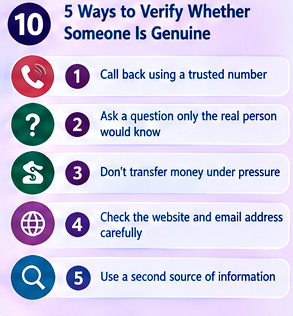
Here are five simple habits that can significantly reduce the risk of falling for an impersonation scam.
1. Call Back Using a Trusted Number
If someone claims to be a family member, bank employee or company representative, don’t simply call back using the number they provide.
Find the legitimate number independently.
Key point: Verify through a communication channel you control.
2. Ask a Question Only the Real Person Would Know
If someone claims to be a family member, ask about something that isn’t publicly available.
Don’t rely on a simple name or birthday if that information could already be available online.
Key point: Use independent information to challenge the identity.
3. Don’t Transfer Money Under Pressure
Never allow someone else’s urgency to become your financial emergency.
Take time to investigate before transferring money, purchasing gift cards or sharing financial information.
Key point: Urgency is not a reason to skip verification.
4. Check the Website and Email Address Carefully
Look closely at:
- Website spelling
- Domain name
- Email address
- Phone number
- Links
- Unexpected attachments
A small difference in a web address or email address can be significant. The FBI specifically recommends carefully examining contact information, URLs and spelling.
Key point: Don’t judge a digital identity by appearance alone.
5. Use a Second Source of Information
This may be the most important habit.
If you receive a surprising message, search for independent confirmation through an official website, trusted news source or another known contact.
The FTC’s longstanding advice for impersonation scams is essentially to stop and check before sending money.
Key point: One communication channel should not be the only evidence you use to make an important decision.
11. AI Does Not Make Every Scam Obvious
It is tempting to believe that we can simply identify AI by looking for strange eyes, unnatural movements or robotic voices.
Unfortunately, that isn’t a reliable strategy.
Key point: Verification is more dependable than trying to detect every AI-generated fake yourself.
12. The Best Defence May Be Simply Slowing Down
The biggest lesson from AI-powered scams is not that we should stop trusting everyone.
It is that we should stop trusting instantly.
A real family member may call.
A real bank employee may contact you.
A real company may send you an email.
But when money, passwords, OTPs, personal information or account access are involved, verification should become automatic.
Take a breath.
End the conversation if necessary.
Contact the person or organisation independently.
Then make your decision.
Key point: In the age of AI, taking a few extra minutes to verify something can be far more valuable than reacting within a few seconds.
Conclusion
Artificial intelligence is not inherently a scam technology. It has enormous legitimate uses in communication, education, business, healthcare, entertainment and many other fields.
But the same capabilities that make AI useful can also make impersonation scams more convincing. Recent warnings from the FBI show that criminals are already using AI-generated voices, videos and spoofed websites in fraud schemes.
The important lesson is therefore simple:
Don’t automatically trust a voice because it sounds familiar. Don’t automatically trust a video because you can see a face. And don’t automatically trust a website because it looks professional.
In the AI era, verification is becoming just as important as recognition.
If something is unexpected, emotional, urgent or financially important, stop, verify and then act.