
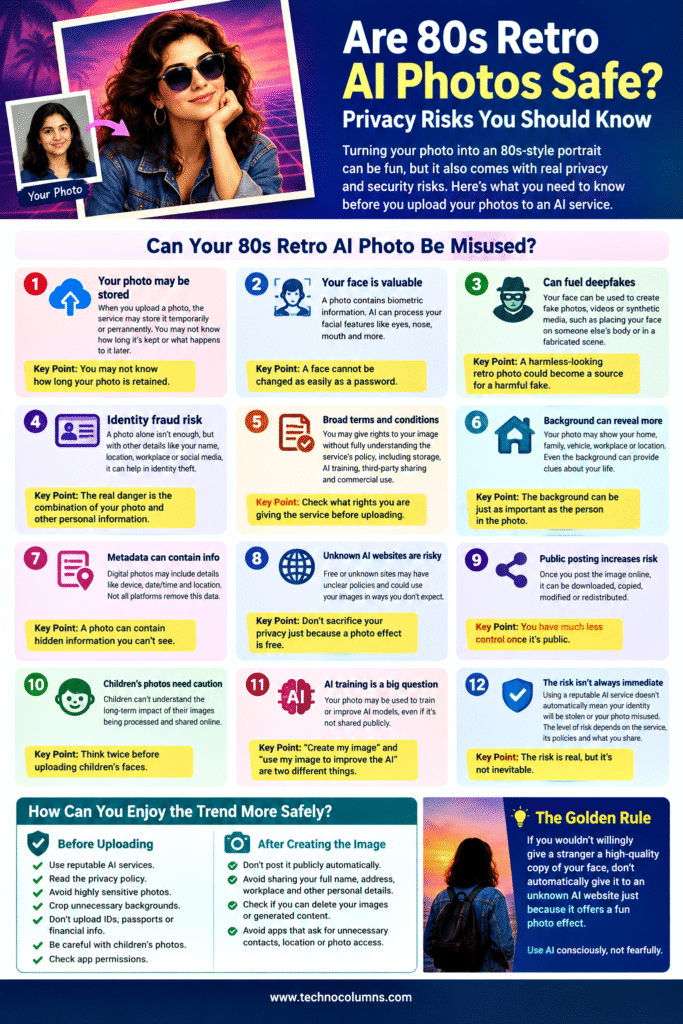
AI-Generated Photos and Privacy: What Can Happen to Your Picture?
The trend of using AI to turn ordinary photographs into 1980s/retro-style portraits can create privacy and security risks, especially when people upload personal photos to unknown AI apps or websites.
Can Your 80s Retro AI Photo Be Misused?
1. Your original photograph may be stored
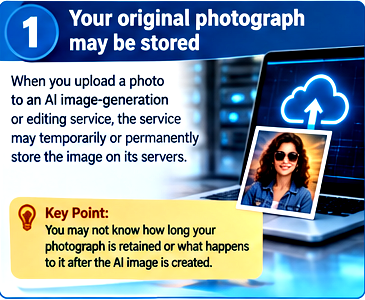
When you upload a photo to an AI image-generation or editing service, the service may temporarily or permanently store the image on its servers.
Key Point: You may not know how long your photograph is retained or what happens to it after the AI image is created.
Some services may delete uploads quickly, while others may retain them for security, troubleshooting, service improvement, or other purposes depending on their policies.
2. Your face is more valuable than an ordinary picture
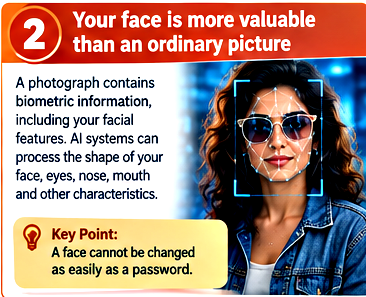
A photograph isn’t simply an image—it can contain biometric information, particularly your facial characteristics.
An AI system can potentially process features such as the shape of your face, eyes, nose, mouth and other characteristics.
Key Point: A face cannot be changed as easily as a password.
If a password is compromised, you can replace it. You cannot simply replace your face.
3. AI images can contribute to deepfakes
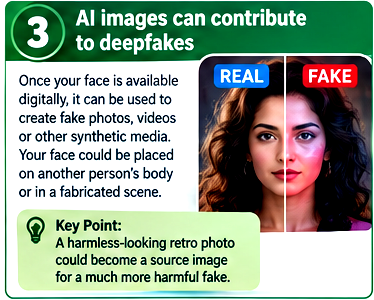
Once someone’s face is available digitally, it can potentially be used to create fake photographs, videos or other synthetic media.
For example, a person’s face could potentially be placed onto another person’s body or incorporated into a completely fabricated scene.
Key Point: A harmless-looking retro photograph could potentially become a source image for a much more harmful fake.
The risk becomes greater when a person has publicly available photographs from multiple angles.
4. Your photograph could be used for identity fraud
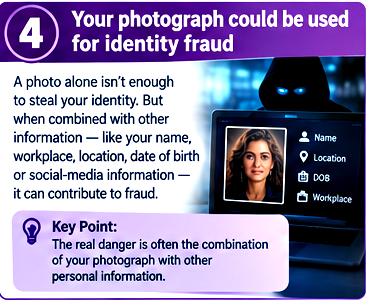
A photograph by itself usually isn’t enough to steal someone’s identity. However, when combined with other information—such as your name, workplace, location, date of birth or social-media information—it can contribute to an identity-fraud attempt.
Key Point: The real danger is often the combination of your photograph with other personal information.
For example, a public social-media profile may reveal much more about you than you realize.
5. Some AI apps may have broad terms and conditions
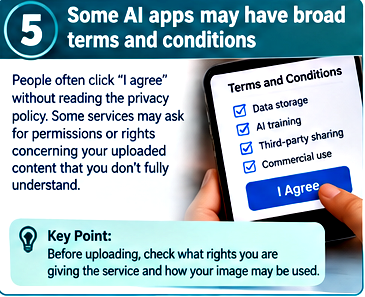
People often click “I agree” without reading the privacy policy or terms of service.
Some services may ask for permissions or rights concerning uploaded content that users don’t fully understand.
Key Point: Before uploading a personal photograph, check what rights you are giving the service and how your image may be used.
Look particularly for information about:
- Image storage
- Data retention
- AI training
- Third-party sharing
- Deletion
- Commercial use
- Account closure and data deletion
6. A retro photograph can reveal more information than intended
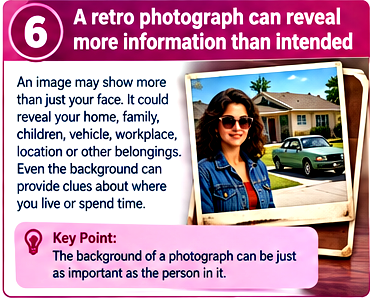
An image may contain more than just your face. Depending on the original photograph, it could reveal your home, family members, children, vehicle, workplace, location or other belongings.
Even the background can provide clues about where someone lives or spends time.
Key Point: The background of a photograph can be just as important as the person in it.
Before uploading, consider cropping or removing unnecessary background information.
7. Metadata can sometimes contain information
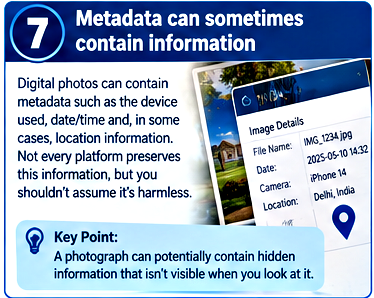
Digital photographs can contain metadata such as the device used to take the photograph, date/time and, in some circumstances, location information.
Not every platform preserves this information, but users shouldn’t assume that metadata is always harmless.
Key Point: A photograph can potentially contain hidden information that isn’t visible when you look at it.
Removing unnecessary metadata before uploading can provide an additional layer of privacy.
8. Unknown AI websites can be particularly risky
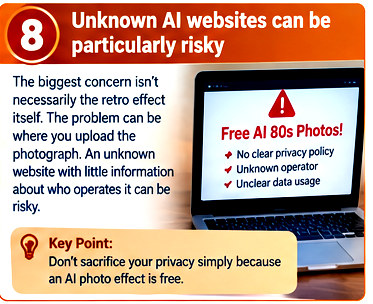
The biggest concern isn’t necessarily the retro effect itself. The problem can be where you upload the photograph.
A well-known service with a clear privacy policy is generally easier to evaluate than an unknown website promising “Free AI 80s Photos” with little information about who operates it.
Key Point: Don’t sacrifice your privacy simply because an AI photo effect is free.
If you don’t know who operates a service or what it does with uploaded images, think twice before using it.
9. Publicly posting the AI image creates another risk
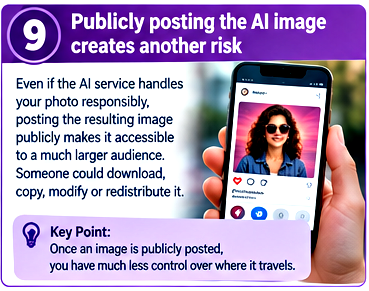
Even if the AI service handles your photograph responsibly, posting the resulting image publicly on Instagram, Facebook, X or other platforms makes it accessible to a much larger audience.
Someone could download, copy, modify or redistribute it.
Key Point: Once an image is publicly posted, you have much less control over where it travels.
Consider limiting the audience for highly personal photographs.
10. Children’s photographs require extra caution
Uploading photographs of children deserves particular care because they cannot fully understand the long-term consequences of having their images processed and distributed online.
Key Point: Think twice before uploading children’s faces to unfamiliar AI services.
Parents should be especially cautious about services that have unclear policies regarding storage, AI training or third-party sharing.
11. AI training is an important question
One of the most important things to check is whether an AI company can use uploaded photographs to train or improve its models.
This doesn’t necessarily mean your exact photograph will appear somewhere publicly. However, users should understand whether their content may be used for purposes beyond simply generating their requested image.
Key Point: “Create my image” and “use my image to improve the AI” are two different things.
Look for the service’s current policy regarding training and uploaded content.
12. The danger is usually not that someone immediately steals your photo
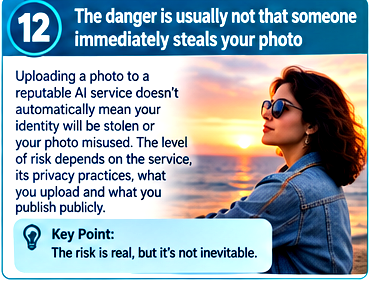
It is important not to become unnecessarily frightened.
Uploading a photograph to a reputable AI service doesn’t automatically mean that your identity will be stolen or that your photograph will be misused.
Key Point: The risk is real, but it is not inevitable.
The level of risk depends on:
- Which AI service you use
- Its privacy practices
- What photograph did you upload
- What information accompanies the photograph
- Whether you publish the result publicly
How Can You Enjoy the Trend More Safely?
You don’t necessarily have to avoid AI retro photographs altogether. A few precautions can significantly reduce the risk.
Before uploading
✅ Use reputable AI services rather than random websites.
✅ Read the privacy policy, particularly the sections concerning uploaded images and AI training.
✅ Avoid uploading highly sensitive photographs.
✅ Crop unnecessary backgrounds containing addresses, documents, vehicles or other identifying information.
✅ Don’t upload photographs containing IDs, passports, certificates or financial information.
✅ Be particularly careful with children’s photographs.
✅ Check app permissions and don’t grant access that isn’t necessary.
After creating the image
✅ Don’t automatically post it publicly.
✅ Avoid adding your full name, address, workplace and other personal information to the post.
✅ Check whether the AI service provides an option to delete uploaded images or generated content.
✅ If an app makes unusual requests—such as unnecessary contacts, location or extensive photo-library access—consider avoiding it.
The Bigger Issue
The 80s retro photo trend itself isn’t inherently dangerous. The important issue is the growing habit of giving AI systems highly personal photographs without considering what happens to those photographs afterwards.
Think of it this way:
Your photograph → AI service → AI processing → potentially stored/shared/processed → AI-generated image → social media
There can be several points in that chain where privacy can become a concern.
The Golden Rule
If you wouldn’t willingly give a stranger a high-quality copy of your face, don’t automatically give it to an unknown AI website just because it offers a fun photo effect.
The best approach is not to fear AI, but to use it consciously. A little caution—particularly about the service you choose, what you upload, and where you publish the result—can let you enjoy the retro-AI trend while substantially reducing your privacy risk.