
How Multiple Lenses Make Smartphone Photos Better
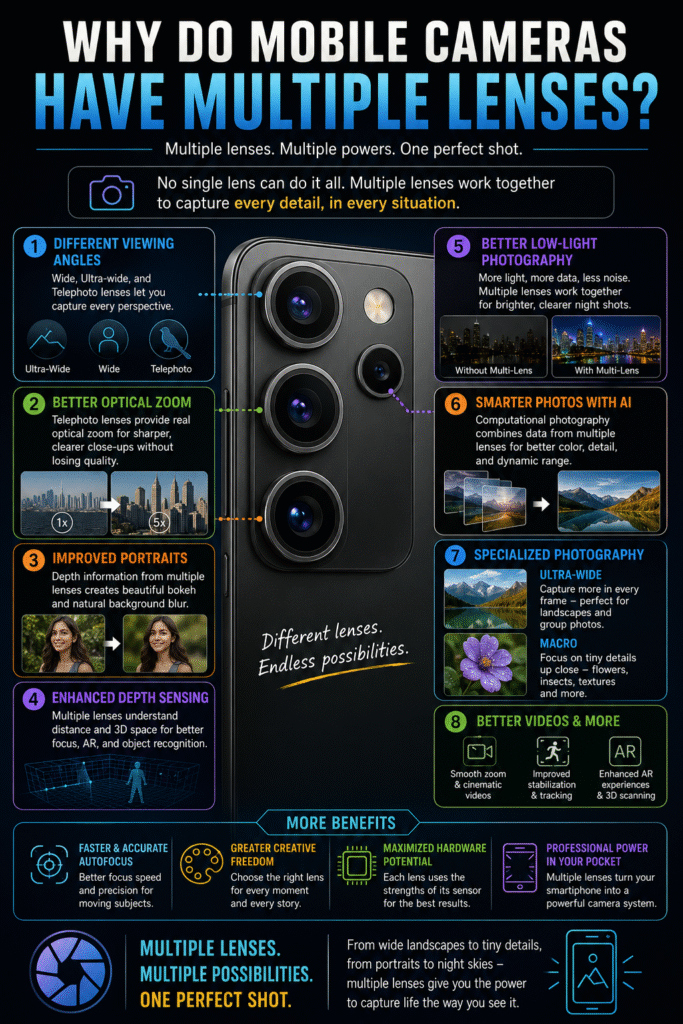
Modern smartphones no longer rely on a single camera lens. Most phones today come with two, three, four, or even more camera lenses on the back. These multiple lenses are not just for appearance; each lens serves a specific purpose and helps improve the overall photography experience. By combining information from different lenses, smartphones can capture images that are sharper, brighter, and more versatile than ever before.
Here are the main reasons why mobile cameras have multiple lenses.
1. Different Lenses Provide Different Viewing Angles
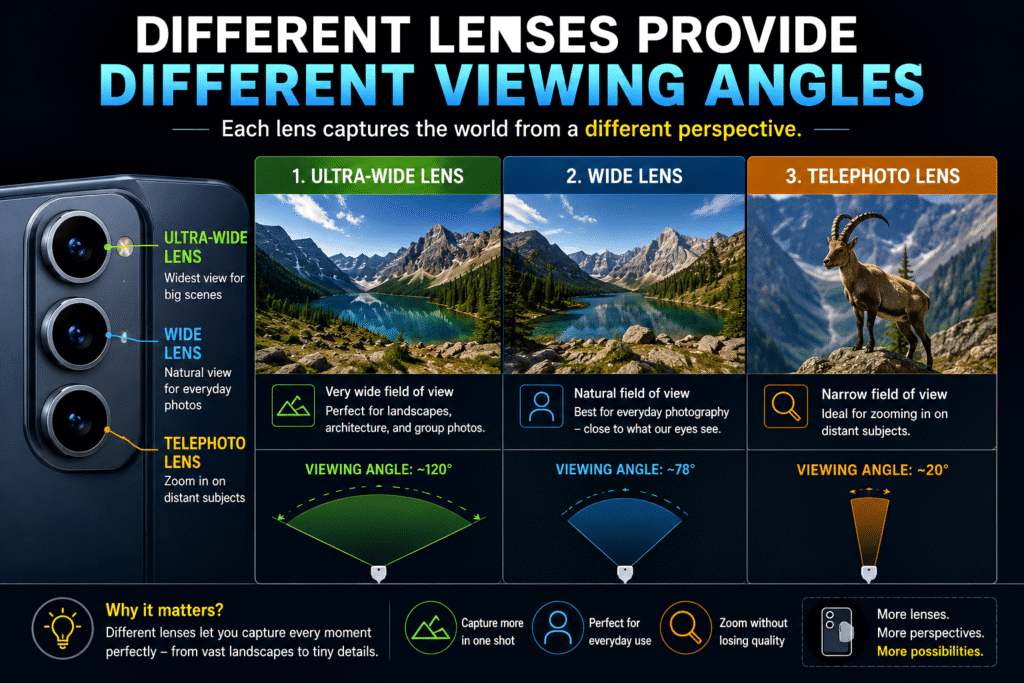
Key Point: Each lens captures the world from a different perspective.
A single camera lens cannot effectively handle every photography situation. Some scenes require a wide field of view, while others require zooming into distant objects.
Manufacturers solve this problem by including multiple lenses such as:
- Wide-angle lens for everyday photography
- Ultra-wide lens for landscapes and group photos
- Telephoto lens for zooming into distant subjects
For example, if you are standing in front of a large mountain range, an ultra-wide lens can capture the entire scene. If you want to photograph a bird sitting on a distant tree, the telephoto lens can bring it closer without physically moving.
Multiple lenses make a smartphone more versatile and capable of handling various photographic situations.
2. Better Optical Zoom Capabilities
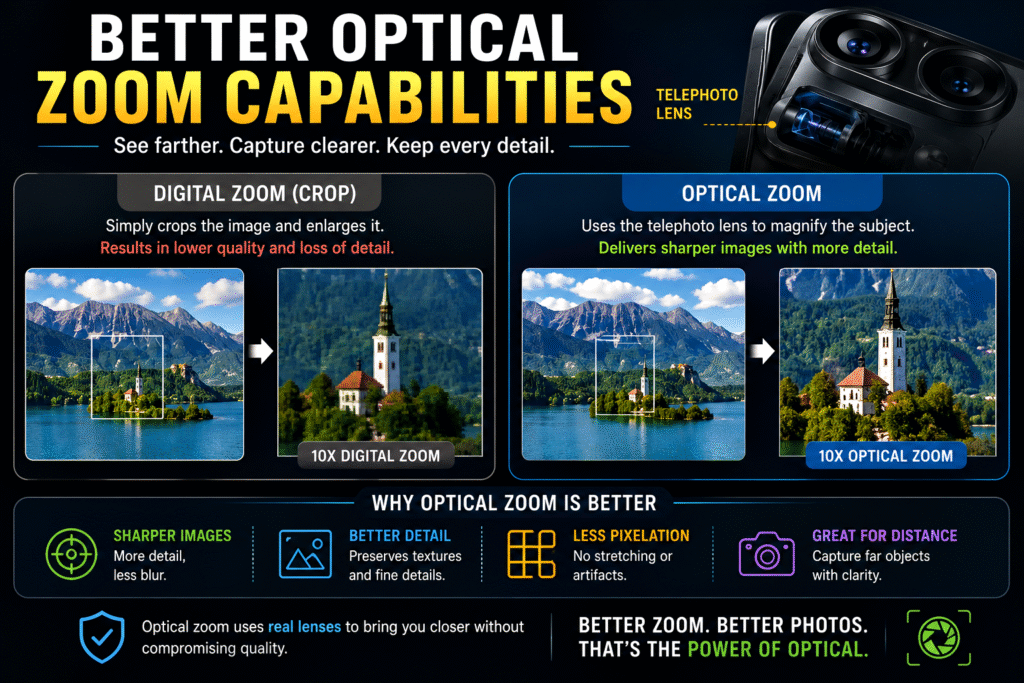
Key Point: Multiple lenses allow real zoom instead of digital zoom.
Traditional digital zoom simply crops the image and enlarges it, often reducing image quality.
A telephoto lens provides optical zoom, which magnifies the subject using actual lens optics rather than software.
Benefits include:
- Sharper zoomed images
- Better detail preservation
- Less pixelation
- Improved long-distance photography
Without a dedicated telephoto lens, distant subjects would appear blurry and less detailed.
This is why premium smartphones often advertise 3x, 5x, or even 10x optical zoom capabilities.
3. Improved Portrait Photography
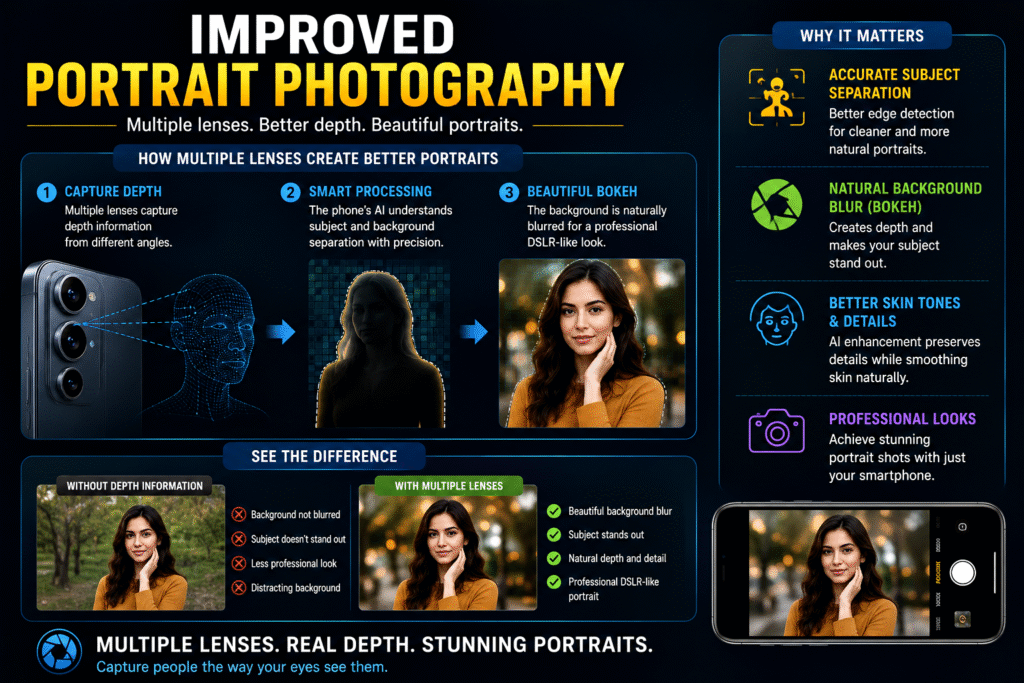
Key Point: Multiple lenses help create professional-looking background blur.
Portrait mode has become one of the most popular smartphone camera features.
To create the attractive blurred background effect known as bokeh, the camera must understand the distance between the subject and the background.
Multiple lenses help by:
- Measuring depth more accurately
- Separating the subject from the background
- Creating smoother blur effects
- Producing more realistic portraits
The result is a photo that resembles images captured by professional DSLR cameras.
4. Enhanced Depth Sensing
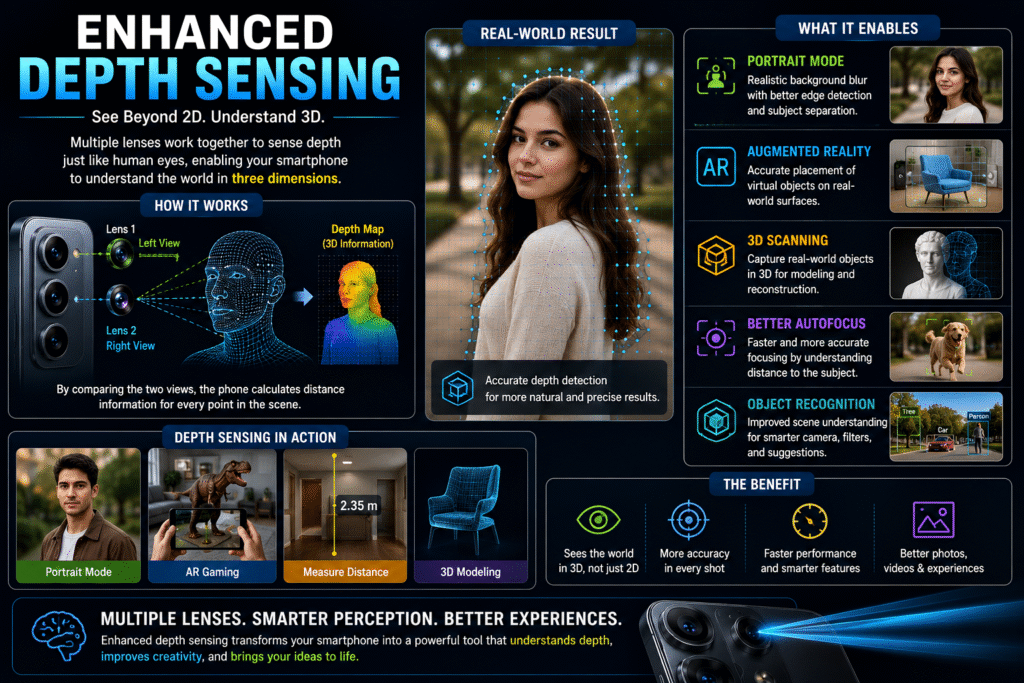
Key Point: Multiple cameras help smartphones understand three-dimensional space.
When two or more lenses view the same object from slightly different angles, the phone can calculate depth much like human eyes do.
This depth information helps with:
- Portrait photography
- Augmented reality (AR)
- 3D scanning
- Better autofocus
- Object recognition
By understanding how far objects are from the camera, smartphones can make more intelligent photography decisions.
5. Better Low-Light Photography
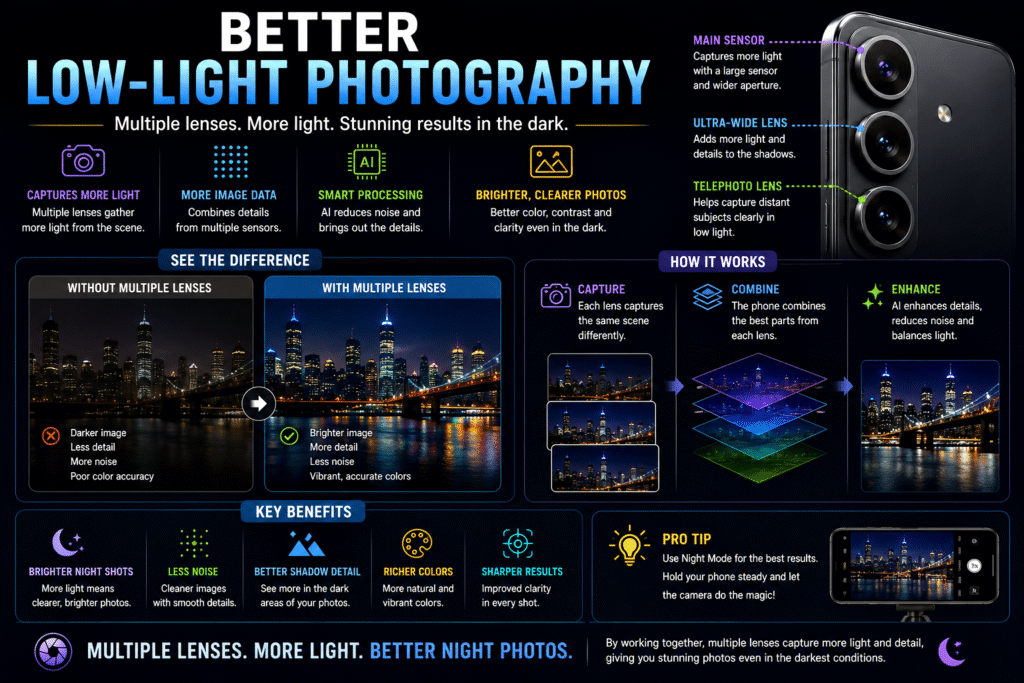
Key Point: Multiple lenses help gather more light and image data.
Low-light photography is challenging because camera sensors receive less light.
Modern smartphones overcome this limitation by combining information from multiple cameras.
Advantages include:
- Brighter night photos
- Reduced image noise
- Better shadow detail
- Improved color accuracy
Some phones use larger sensors in one lens while using additional lenses to provide extra image information.
The final image is created by merging data from several cameras, resulting in significantly better nighttime photographs.
6. Improved Image Quality Through Computational Photography
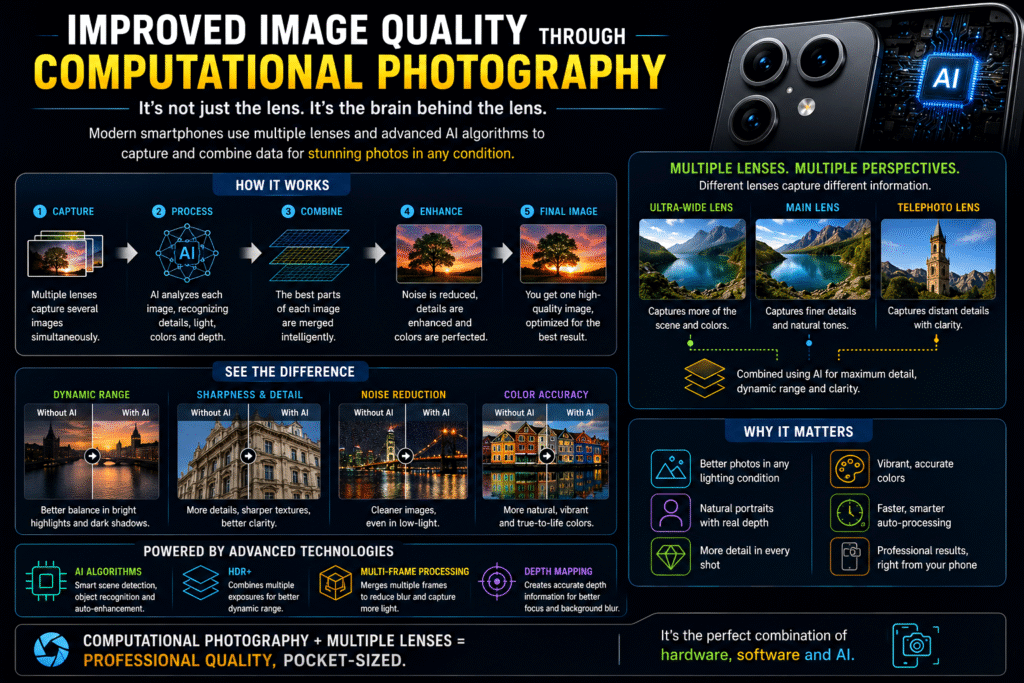
Key Point: Multiple cameras work together with AI to create better photos.
Today’s smartphones rely heavily on computational photography.
Instead of depending solely on hardware, the phone uses artificial intelligence and image processing to combine information from multiple cameras.
This process helps achieve:
- Better dynamic range
- Improved sharpness
- Enhanced colors
- Reduced noise
- More accurate exposure
Several images may be captured simultaneously from different lenses and then merged into a single high-quality photograph.
This is one of the biggest reasons smartphone cameras have improved so dramatically over the last decade.
7. Ultra-Wide Photography
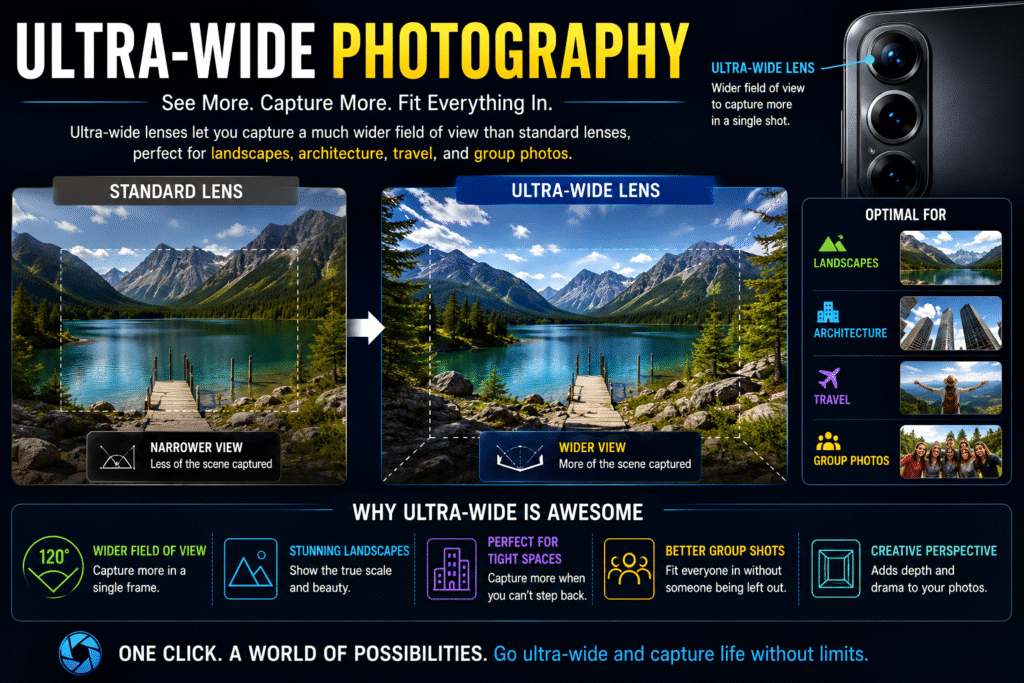
Key Point: Ultra-wide lenses capture much larger scenes.
A standard camera lens cannot always fit everything into the frame.
An ultra-wide lens allows users to capture:
- Landscapes
- Architecture
- Large buildings
- Group photos
- Interior spaces
This lens provides a wider field of view, making it ideal for travel and outdoor photography.
Without an ultra-wide lens, users would often need to move farther away from the subject, which is not always possible.
8. Better Macro Photography
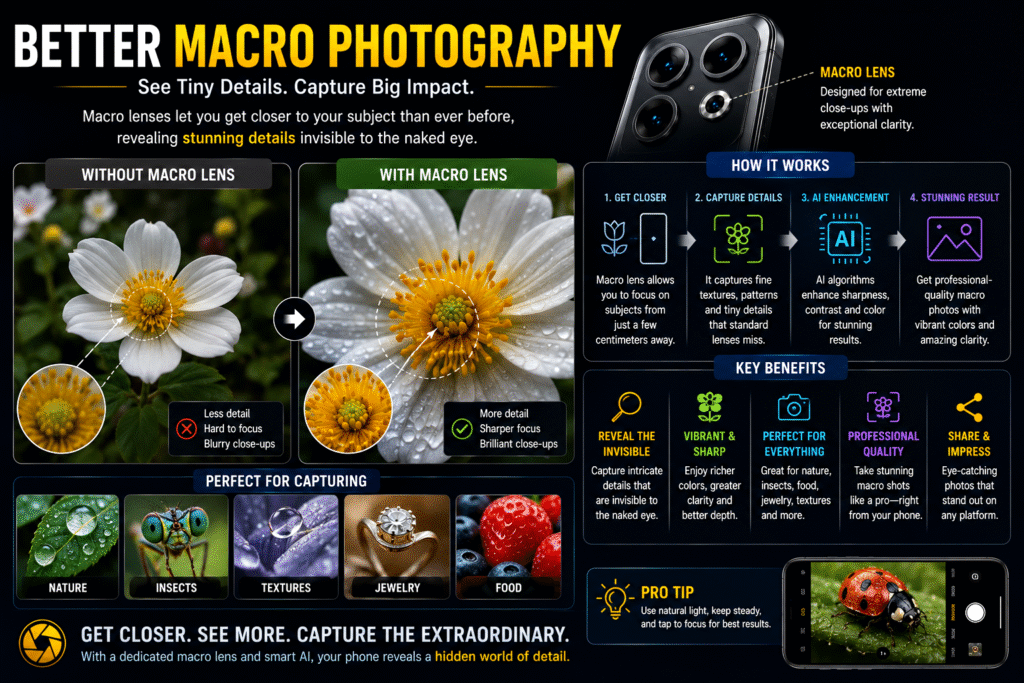
Key Point: Specialized lenses can focus on extremely close subjects.
Some smartphones include dedicated macro lenses.
These lenses are designed to photograph tiny objects from very short distances.
Examples include:
- Flowers
- Insects
- Jewelry
- Water droplets
- Textures
Macro lenses reveal details that are often invisible to the naked eye.
This capability adds another creative option for smartphone photographers.
9. Faster and More Accurate Autofocus
Key Point: Multiple lenses improve focusing speed and precision.
Autofocus systems perform better when they have more visual information.
Additional lenses help the phone determine:
- Subject distance
- Movement direction
- Focus accuracy
Benefits include:
- Faster focus acquisition
- Better subject tracking
- Improved action photography
- Reduced focus hunting
This is especially useful when photographing moving subjects such as children, pets, or sports activities.
10. Improved Video Recording
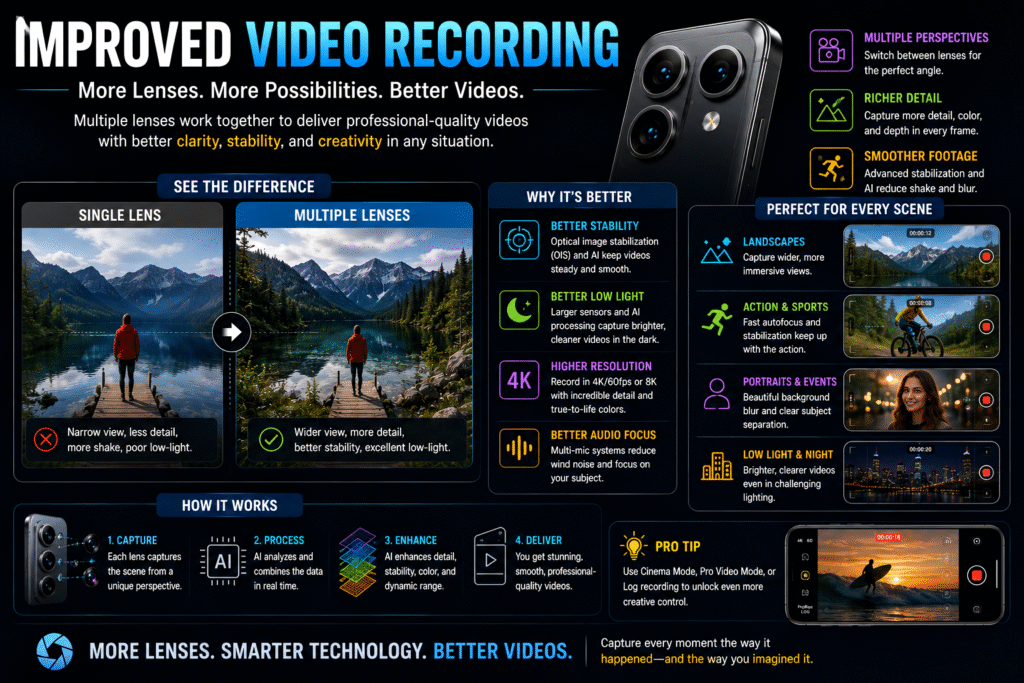
Key Point: Multiple lenses enhance video quality and flexibility.
Modern smartphones are increasingly used for professional-level video recording.
Multiple lenses provide:
- Smooth zoom transitions
- Better stabilization
- Wider shooting options
- Improved cinematic effects
Users can switch seamlessly between ultra-wide, standard, and telephoto views while recording.
This flexibility allows content creators to produce more dynamic and engaging videos.
11. Support for Augmented Reality (AR)
Key Point: Multiple cameras improve AR accuracy.
Augmented Reality applications place virtual objects into real-world environments.
To do this accurately, the smartphone must understand:
- Surface locations
- Object distances
- Room dimensions
Multiple cameras help build a more accurate depth map.
This improves experiences in:
- AR gaming
- Virtual furniture placement
- Navigation
- Education apps
As AR technology advances, multiple camera systems become even more important.
12. Greater Creative Freedom for Users
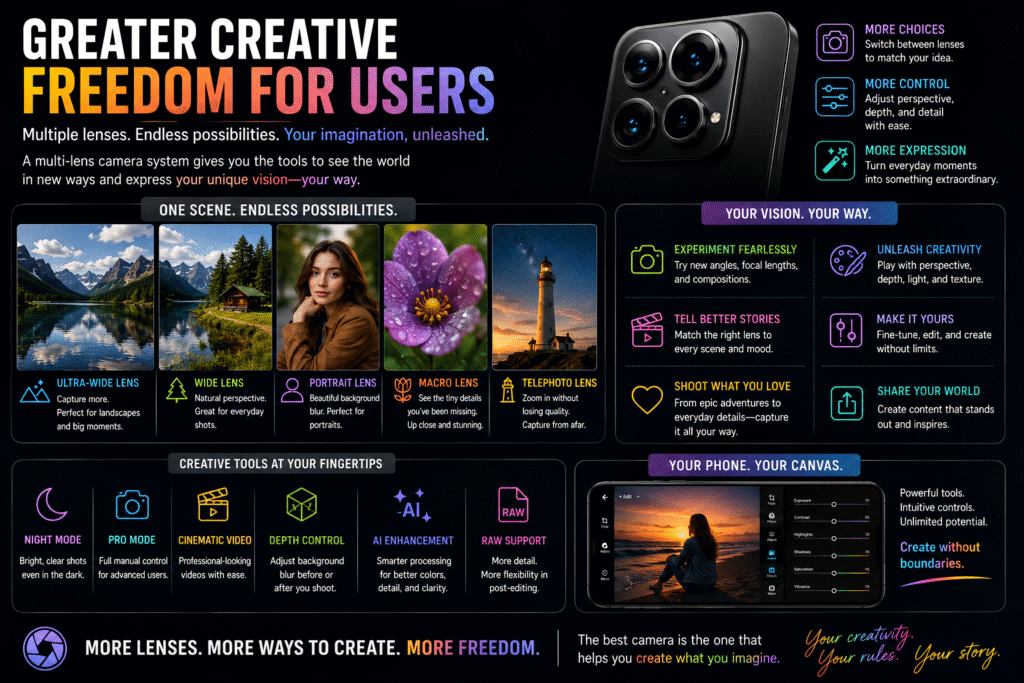
Key Point: Multiple lenses give photographers more shooting options.
Professional photographers carry several lenses for different situations.
Smartphones mimic this flexibility by including multiple built-in lenses.
Users can quickly switch between:
- Ultra-wide shots
- Standard photos
- Zoomed images
- Macro photography
- Portrait mode
This allows creative experimentation without carrying additional equipment.
Conclusion
Key Point: Multiple lenses transform smartphones into versatile photography tools.
Mobile phones have multiple camera lenses because no single lens can perform every photographic task effectively. Different lenses provide different viewing angles, zoom capabilities, depth information, and specialised functions. Combined with advanced software and artificial intelligence, these lenses work together to produce high-quality photos and videos in almost any situation.
The result is a camera system that can capture landscapes, portraits, close-ups, nighttime scenes, and distant subjects—all from a device that fits comfortably in your pocket. As smartphone technology continues to evolve, multiple-lens camera systems will remain a key factor in delivering professional-level photography to everyday users.