
The Secret Purpose of the Plastic Tongue Inside Every USB Port
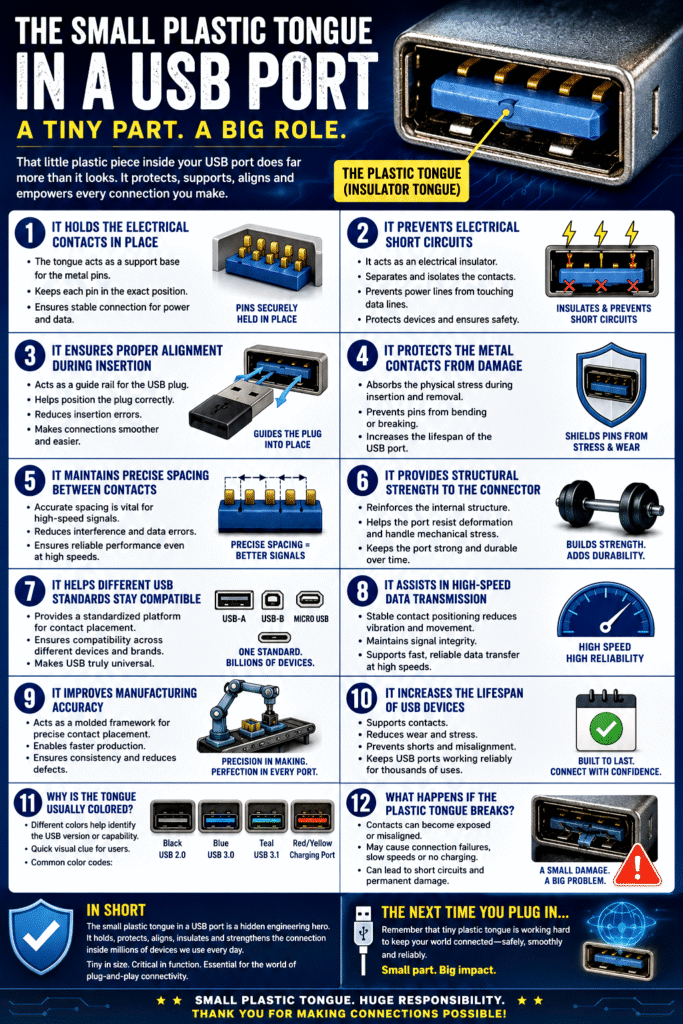
If you have ever looked closely inside a USB port, you may have noticed a small plastic piece located in the middle of the connector. This part is often called the plastic tongue or insulator tongue. Although it appears to be a simple piece of plastic, it plays a vital role in the operation, safety, and durability of USB connections.
Without this tiny component, USB devices would not function reliably, and the risk of damage to both the port and connected devices would increase significantly. Let us explore the importance of this small plastic tongue in detail.
1. It Holds the Electrical Contacts in Place
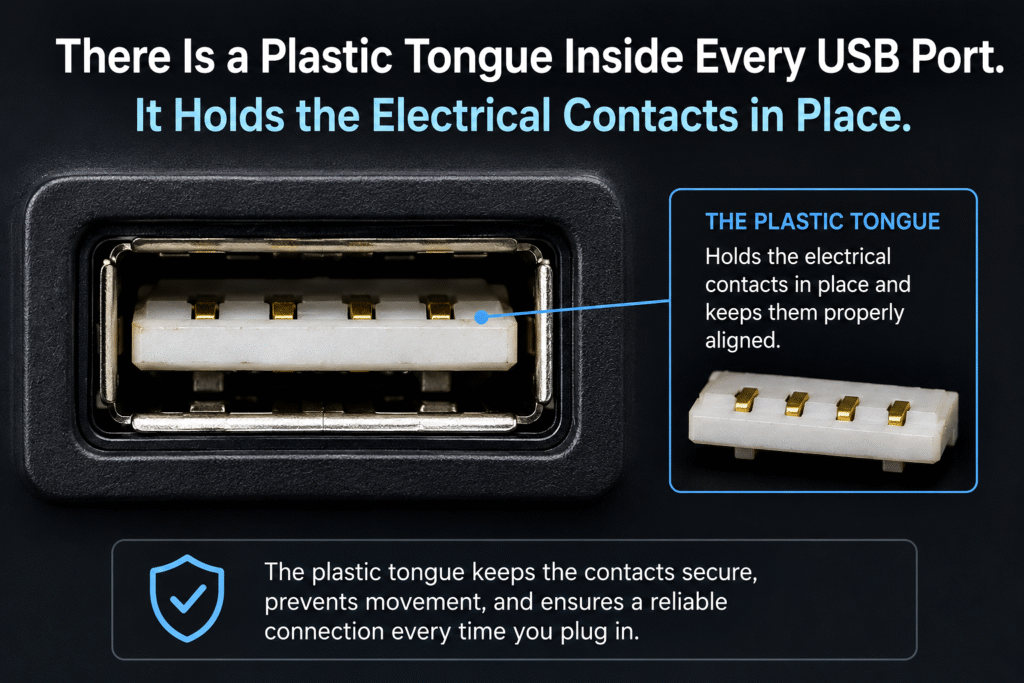
Key Point: The plastic tongue acts as a support structure for the metal contact pins.
Inside every USB connector are several tiny metal contacts. These contacts carry power and data between devices.
The metal pins are extremely thin and delicate. If they were left unsupported, they could easily bend, shift, or break during repeated insertion and removal of USB devices.
The plastic tongue provides a rigid base that securely holds these contacts in their exact positions. This ensures that:
- Each pin aligns properly with its matching pin.
- Data signals are transmitted accurately.
- Power is delivered safely.
- Connections remain stable over time.
Think of the plastic tongue as the foundation of a building. The metal contacts are like the walls and rooms. Without a strong foundation, everything else would become unstable.
This is perhaps the most important function of the plastic tongue because the entire USB communication system depends on precise pin alignment.
2. It Prevents Electrical Short Circuits
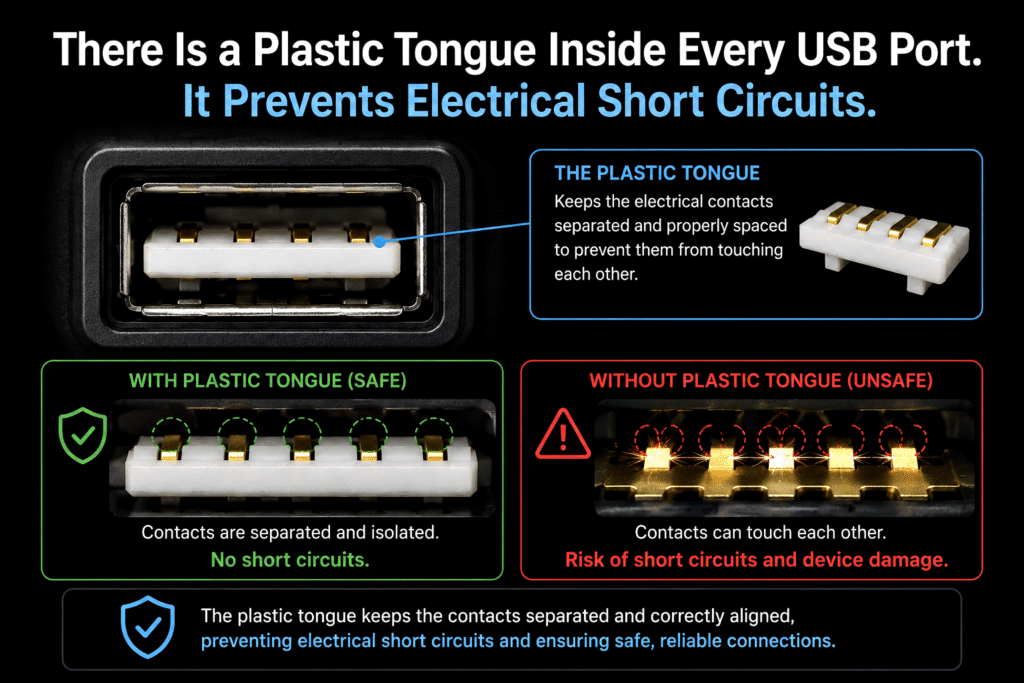
Key Point: The plastic tongue acts as an electrical insulator.
USB connectors contain multiple metal contacts placed very close together.
For example, modern USB connectors may include contacts for:
- Power supply
- Ground connection
- Data transmission
- High-speed communication channels
If these contacts accidentally touched each other, an electrical short circuit could occur.
The plastic tongue separates the contacts and keeps them isolated from one another.
This insulation provides several benefits:
- Prevents power lines from touching data lines.
- Protects connected devices.
- Reduces the risk of overheating.
- Ensures proper signal transmission.
Without this insulating barrier, USB devices could malfunction or even become permanently damaged.
The plastic tongue therefore serves as an invisible safety shield inside the connector.
3. It Ensures Proper Alignment During Insertion
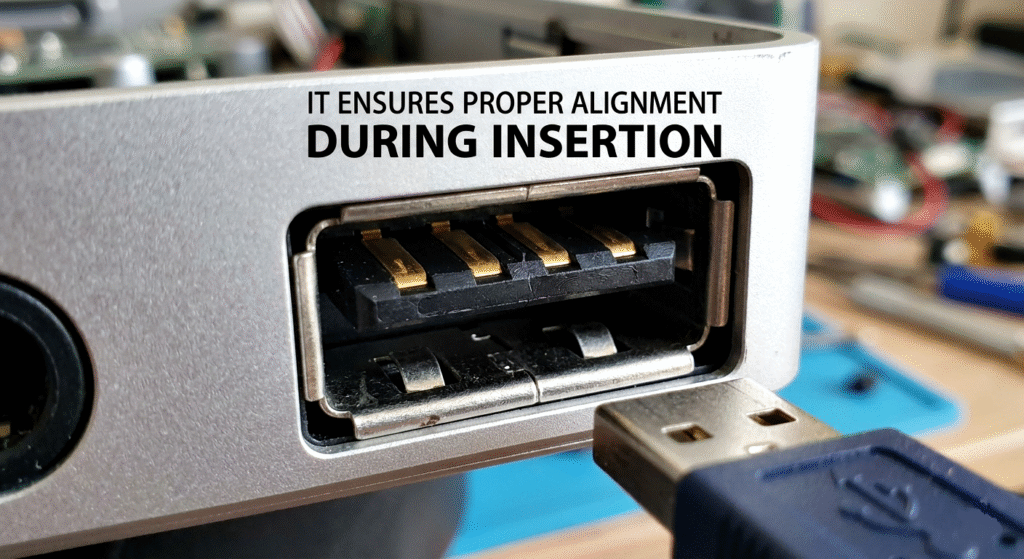
Key Point: The tongue helps guide the connector into the correct position.
When you insert a USB plug into a port, the metal contacts on the plug must line up perfectly with the contacts inside the port.
The plastic tongue acts as a guide rail that helps position the plug correctly.
This guidance:
- Reduces connection errors.
- Improves reliability.
- Prevents contact misalignment.
- Makes insertion smoother.
Imagine trying to insert a key into a lock without the grooves that guide it. It would be much harder to position correctly.
Similarly, the plastic tongue helps the USB plug slide into place and establish a reliable connection.
4. It Protects the Metal Contacts from Damage
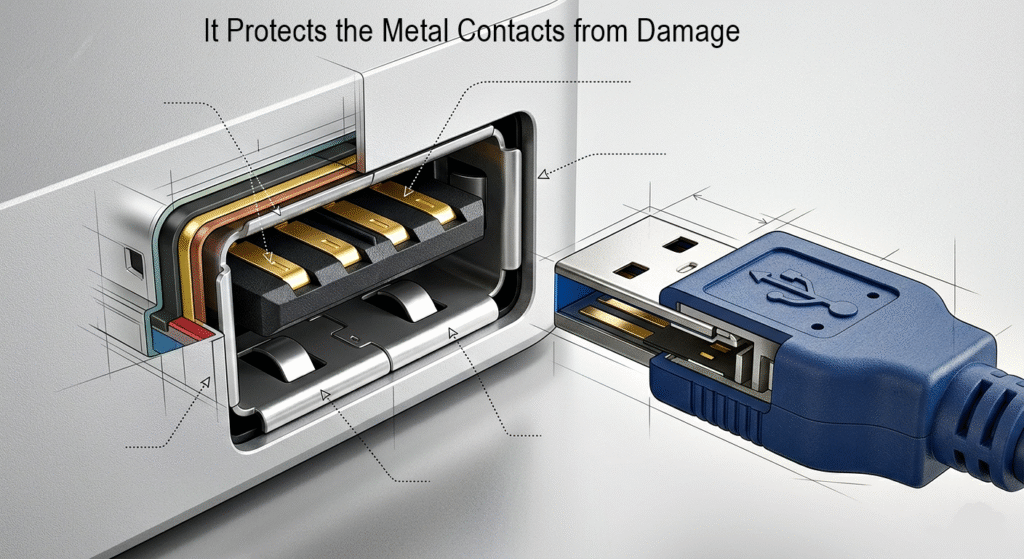
Key Point: The tongue reduces stress on the electrical pins.
USB ports are used thousands of times during their lifetime.
Every insertion and removal creates mechanical stress inside the connector.
Without a protective structure:
- Pins could bend.
- Contacts could wear out faster.
- Connections could become unreliable.
The plastic tongue absorbs much of the physical force generated during insertion.
Because the metal contacts are embedded within the plastic, they experience less direct pressure.
This design greatly increases the lifespan of the USB port.
Many USB ports continue functioning for years precisely because the plastic tongue protects the internal contacts from excessive wear.
5. It Maintains Precise Spacing Between Contacts
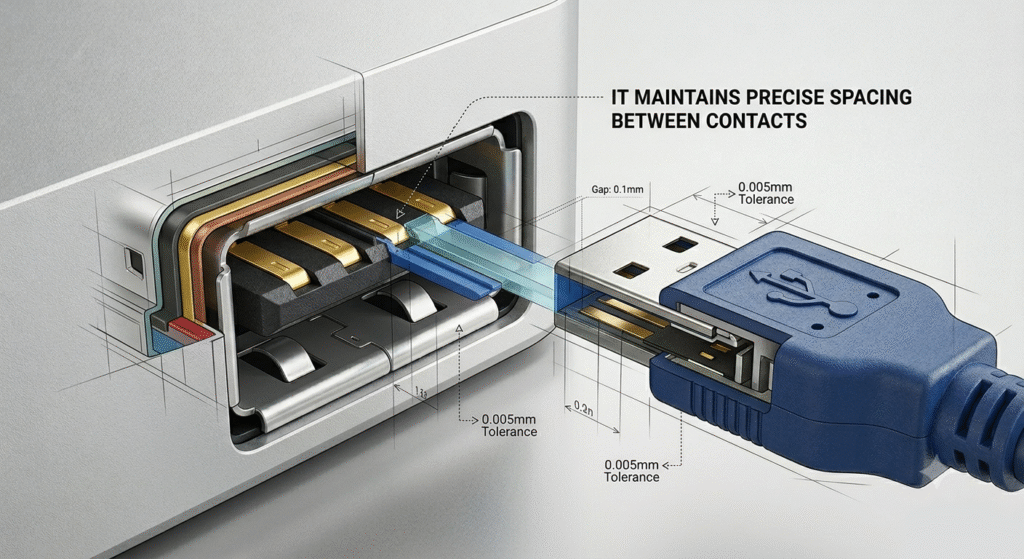
Key Point: Signal integrity depends on accurate contact spacing.
Modern USB standards support extremely high data transfer rates.
Examples include:
- USB 2.0
- USB 3.0
- USB 3.2
- USB4
At high speeds, even tiny changes in pin spacing can affect signal quality.
The plastic tongue ensures that:
- Contacts remain evenly spaced.
- Signal interference is minimized.
- Data errors are reduced.
- High-speed communication remains stable.
This precision becomes increasingly important as USB technology evolves.
A tiny variation measured in fractions of a millimeter can impact performance in high-speed data transmission.
The plastic tongue helps maintain this critical precision.
6. It Provides Structural Strength to the Connector
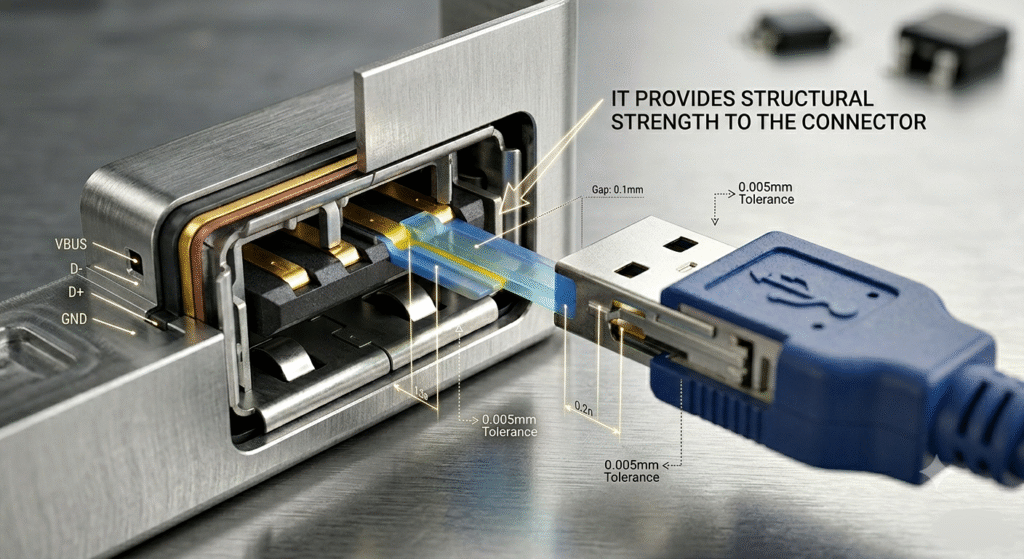
Key Point: The tongue reinforces the internal architecture of the port.
A USB port experiences constant physical interaction.
Users often:
- Insert connectors quickly.
- Pull cables at angles.
- Apply accidental pressure.
The plastic tongue adds rigidity to the connector’s internal structure.
This reinforcement helps the port:
- Resist deformation.
- Maintain shape.
- Handle mechanical stress.
- Stay functional for longer periods.
Without this support, the connector would be much weaker and more prone to failure.
7. It Helps Different USB Standards Maintain Compatibility
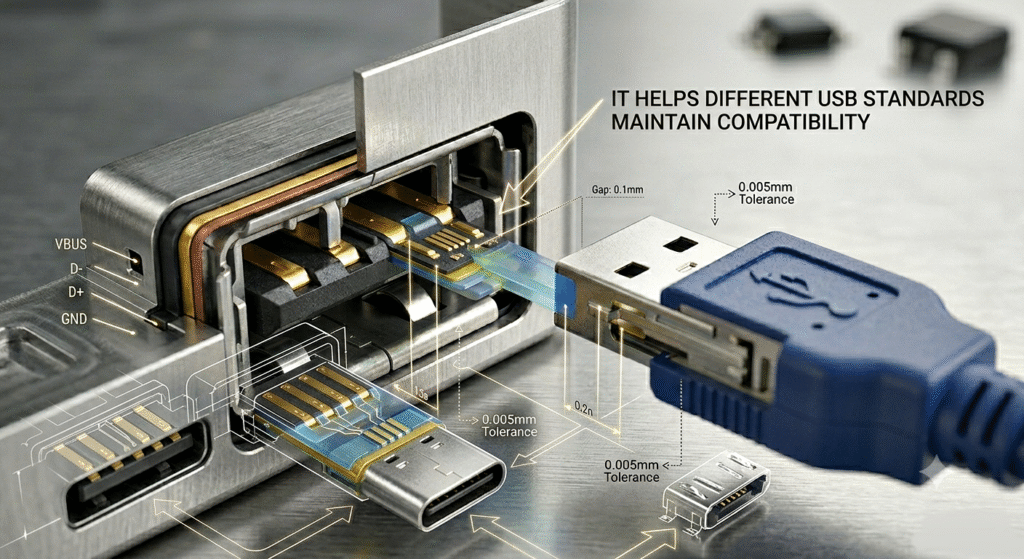
Key Point: The tongue provides a standardized platform for contact placement.
USB technology has evolved dramatically since its introduction.
Different versions include:
- USB Type-A
- USB Type-B
- Mini USB
- Micro USB
- USB-C
Although designs vary, the basic principle remains similar.
The plastic tongue serves as a standardized structure that allows manufacturers to place contacts consistently across millions of devices.
This consistency enables:
- Universal compatibility.
- Reliable manufacturing.
- Easy device integration.
- Predictable performance.
Without such standardisation, USB devices from different manufacturers might not work together properly.
8. It Assists in High-Speed Data Transmission
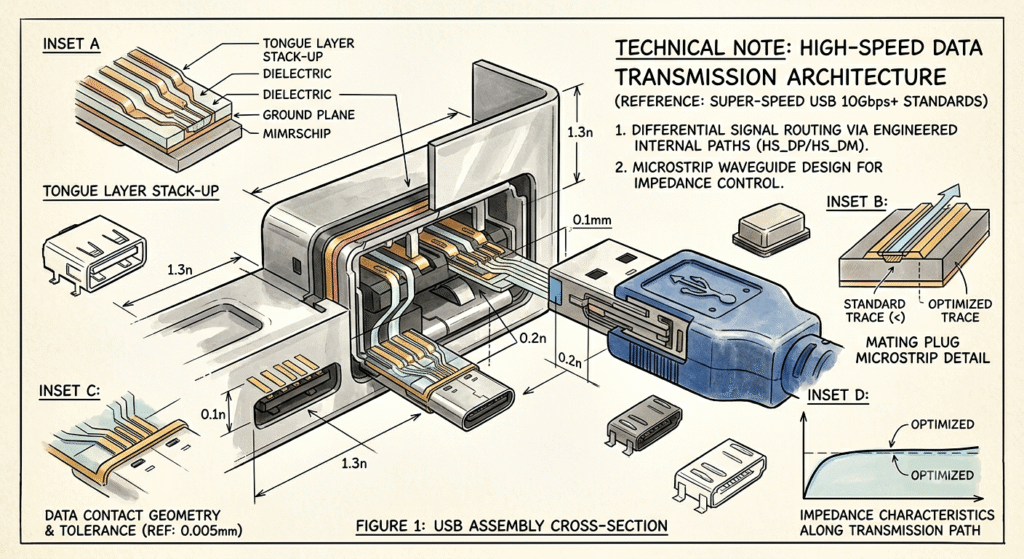
Key Point: Stable contact positioning improves signal quality.
Modern USB connections transfer enormous amounts of data every second.
For example:
- USB 3.2 can transfer data at multiple gigabits per second.
- USB4 reaches even higher speeds.
At these speeds, electrical signals become highly sensitive.
The plastic tongue helps by:
- Keeping contacts stable.
- Reducing vibration.
- Preventing movement.
- Maintaining electrical consistency.
Even microscopic shifts in contact positions can introduce signal noise.
The tongue ensures a stable environment for reliable communication.
9. It Improves Manufacturing Accuracy
Key Point: The tongue simplifies mass production.
Billions of USB connectors are manufactured worldwide.
To achieve consistent quality, manufacturers need precise component placement.
The plastic tongue serves as a molded framework where contacts can be installed with high accuracy.
Benefits include:
- Faster production.
- Lower manufacturing costs.
- Better consistency.
- Reduced defect rates.
Because the contacts are mounted into a predefined structure, assembly becomes more reliable and efficient.
This contributes to the affordability and widespread availability of USB technology.
10. It Increases the Lifespan of USB Devices

Key Point: Durability depends heavily on the tongue’s design.
USB connectors are expected to survive thousands of insertion cycles.
The plastic tongue contributes to longevity by:
- Supporting contacts.
- Reducing mechanical stress.
- Preventing shorts.
- Maintaining alignment.
Without it, connectors would wear out much more quickly.
The result would be:
- Frequent connection failures.
- Data transfer interruptions.
- Device damage.
- Increased replacement costs.
The small plastic tongue therefore plays a major role in the long-term reliability of USB technology.
11. Why Is the Tongue Usually Colored?
Key Point: Color often indicates USB type.
You may have noticed different colors inside USB ports.
Common examples include:
- Black – USB 2.0
- Blue – USB 3.0
- Teal – USB 3.1
- Red or Yellow – Charging ports
The plastic tongue provides a convenient location for these colors.
This helps users quickly identify the capabilities of a USB port.
Although color standards are not always followed perfectly, they often provide useful clues.
12. What Happens If the Plastic Tongue Breaks?
Key Point: A damaged tongue can cause serious problems.
If the tongue cracks or breaks:
- Contacts may become exposed.
- Pins may bend.
- Connections may fail.
- Short circuits may occur.
Common symptoms include:
- Devices disconnecting randomly.
- Slow data transfers.
- Charging problems.
- Complete port failure.
In most cases, a broken tongue means the USB port should be repaired or replaced.
Because the tongue performs so many critical functions, damage to it often compromises the entire connector.
Conclusion
The small plastic tongue inside a USB port may look insignificant, but it is one of the most important components of the connector. It holds the electrical contacts in place, prevents short circuits, guides insertion, protects delicate pins, maintains precise spacing, supports high-speed communication, strengthens the connector, and extends the life of the USB port.
In other words, this tiny piece of plastic is the hidden engineering hero that makes USB technology reliable and durable. The next time you plug in a USB device, remember that the small plastic tongue is doing far more work than its simple appearance suggests. Without it, the modern world of plug-and-play connectivity would be far less dependable.