
How to Identify AI Voice Cloning Scams and Protect Yourself
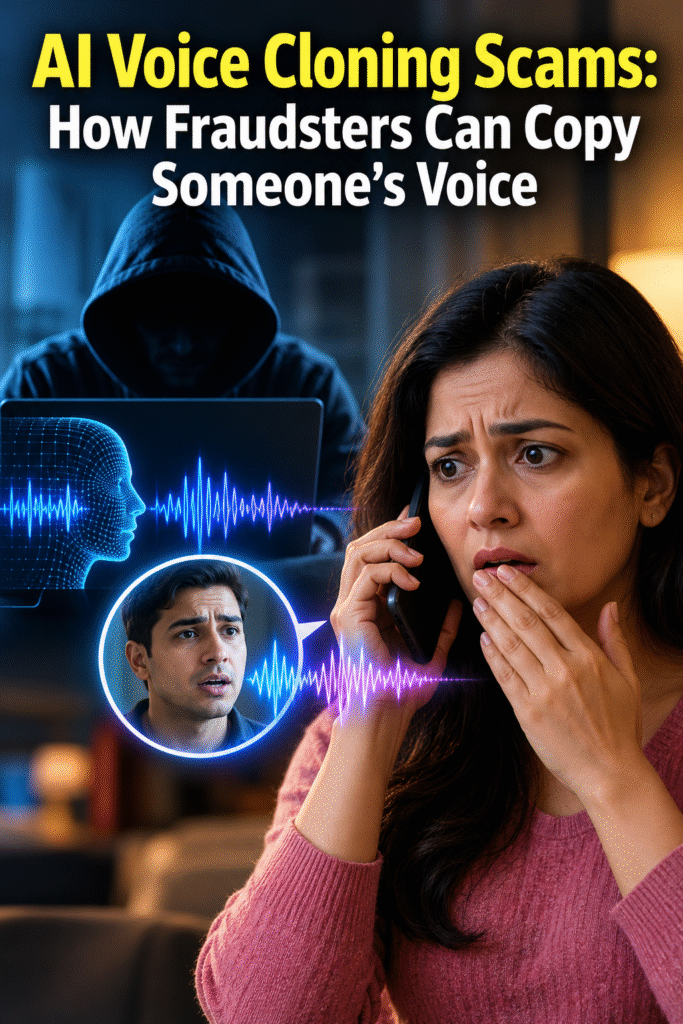
Imagine receiving a phone call from your son, daughter, friend, or another family member asking for urgent financial help. The voice sounds exactly like the person you know. You recognise their way of speaking, their accent, and even their emotions. Naturally, you may believe the call is genuine.
But what if the person speaking is not actually your family member?
With the development of Artificial Intelligence (AI), fraudsters can now create artificial copies of real people’s voices. This technology, known as AI voice cloning, is increasingly being misused to deceive people and commit financial fraud.
What makes these scams particularly dangerous is that criminals no longer need to physically imitate someone. They can use AI to generate a voice that sounds remarkably similar to the original person.
Let’s understand how AI voice cloning scams work, why they are dangerous, and how you can protect yourself.
1. What Is AI Voice Cloning?

AI voice cloning is a technology that uses artificial intelligence to reproduce someone’s voice. It analyses recordings of a person’s speech and learns their pronunciation, accent, tone, and speaking style.
After analysing the audio, an AI system can generate new speech that sounds similar to the original speaker.
For example, imagine someone uploads a recording of your voice to an AI tool. Depending on the tool and the quality of the recording, it may be possible to generate new sentences that sound as though you are speaking them.
Although this technology has legitimate uses in entertainment, accessibility, dubbing, and content creation, criminals can misuse it for impersonation and fraud.
Key points:
- AI voice cloning can reproduce the sound and speaking style of a real person.
- It can generate sentences that the original person never actually spoke.
- Publicly available audio recordings can sometimes be misused.
- The same technology can be used for both legitimate purposes and criminal activities.
2. How Do Fraudsters Clone Someone’s Voice?
One reason voice cloning is becoming a serious concern is that criminals may not need hours of recorded speech.
They may collect audio from social media videos, public interviews, online meetings, or other recordings.
AI tools analyse the available voice samples and create a digital voice model. Fraudsters can then use that model to generate artificial speech.
For instance, someone regularly posting videos on social media may unknowingly make their voice recordings available to people who could misuse them.
The generated voice may then be used to make a fraudulent phone call or send an artificial voice message.
Key points:
- Fraudsters may collect voice samples from publicly available recordings.
- AI systems analyse pronunciation, accent, tone, and speaking patterns.
- Artificial speech can be generated using the cloned voice.
- A person’s ordinary online recordings may become potential material for impersonation.
3. How Do AI Voice Cloning Scams Work?
A common scam involves pretending to be a family member who urgently needs money.
Imagine receiving a call from someone who sounds exactly like your brother. He claims that he has met with an accident and needs immediate financial assistance.
Because the voice sounds familiar and the situation appears urgent, you may transfer money without checking whether the call is genuine.
In reality, a fraudster may be using an AI-generated voice to impersonate your brother.
Criminals may also pretend to be company executives, bank representatives, colleagues, or government officials to convince victims to transfer money or disclose confidential information.
Key points:
- Fraudsters use familiar voices to gain people’s trust.
- They often create emergency situations to make victims panic.
- They may request money transfers or confidential information.
- Emotional pressure is used to prevent victims from verifying the story.
4. Why Are AI Voice Cloning Scams So Dangerous?

Traditional phone scams often involve unfamiliar voices, suspicious requests, or unusual behaviour. People may recognise these warning signs and become cautious.
AI voice cloning changes this situation because the caller may sound like someone the victim knows personally.
Human beings naturally trust familiar voices, especially when the caller claims to be a close family member or friend.
Another problem is that these calls may create emotional pressure. A victim who believes that a loved one is in danger may not think logically before acting.
This makes AI voice scams particularly concerning for elderly people, busy professionals, and anyone who receives an emergency call.
Key points:
- A familiar voice can create a false sense of trust.
- Emotional situations can affect a person’s ability to make careful decisions.
- Victims may transfer money before verifying the caller.
- Even digitally aware people can be deceived by convincing impersonation.
5. Can You Identify an AI-Cloned Voice?
Identifying an AI-generated voice is becoming increasingly difficult as technology improves.
However, some suspicious signs may help you recognise a possible scam.
Listen carefully for unnatural pauses, unusual pronunciation, strange background sounds, or speech that lacks the natural variation of ordinary conversation.
Sometimes the caller may respond awkwardly when asked unexpected questions.
However, these signs are not reliable proof. Modern AI-generated voices can sound natural, and genuine phone calls can also have poor audio quality.
Therefore, never depend only on how a voice sounds to decide whether a caller is genuine.
Key points:
- Unnatural pauses or unusual speech patterns may indicate suspicious audio.
- Unexpected or irrelevant responses can be warning signs.
- Background sounds and voice quality are not reliable tests.
- Voice recognition alone cannot guarantee that a caller is genuine.
6. How Can You Protect Yourself from AI Voice Cloning Scams?

The best protection is to develop a habit of verifying unexpected requests, particularly those involving money or personal information.
You can take several simple precautions.
Key points:
- Create a family verification code: Agree on a secret word or phrase with close family members that can be used during emergencies.
- Call back on a known number: If someone requests money, disconnect and contact that person using their saved phone number.
- Ask personal questions: Ask something that an impersonator may not easily know. However, do not treat the answer alone as proof.
- Avoid immediate money transfers: Take time to verify the emergency before sending money.
- Limit public voice recordings: Be thoughtful about sharing personal audio and video publicly.
- Warn elderly family members: Explain that even a familiar voice on the phone may not always be genuine.
These precautions can make it much harder for fraudsters to exploit your trust.
7. How Can Businesses Become Targets of Voice Cloning?

AI voice cloning is not limited to family-related scams. Businesses can also become victims.
Imagine an employee receiving a call that appears to come from the company’s senior executive. The caller instructs the employee to transfer money urgently to a particular bank account.
If the voice sounds exactly like the executive, the employee may follow the instructions without questioning them.
Businesses may also face impersonation attempts involving suppliers, customers, financial departments, and senior management.
To prevent such incidents, companies should establish clear verification procedures for financial transactions and sensitive instructions.
Key points:
- Fraudsters may impersonate senior executives to manipulate employees.
- Fake voice instructions can be used to request fraudulent payments.
- Financial transactions should require independent verification.
- Businesses should train employees to recognise AI impersonation attempts.
8. What Should You Do If You Receive a Suspicious AI Voice Call?
If you receive a suspicious call, the first thing to remember is not to panic.
Even if the caller sounds like someone you know, avoid making immediate financial decisions.
Disconnect the call and contact the person through another trusted communication method. If the person cannot be reached, contact another family member or someone who can independently verify the situation.
If you have already transferred money because of a suspected voice-cloning scam, contact your bank immediately and report the incident to the appropriate cybercrime authorities.
In India, you can report financial cyber fraud through the national cybercrime helpline 1930 or the official portal cybercrime.gov.in.
Key points:
- Do not act under pressure during an unexpected emergency call.
- Verify the caller’s identity through an independent communication channel.
- Contact your bank immediately if money has been transferred fraudulently.
- Report suspected cybercrime to the appropriate authorities.
9. Can AI Technology Help Detect AI Voice Cloning?

Interestingly, artificial intelligence can also help fight the misuse of AI.
Researchers and technology companies are developing tools that analyse audio recordings to identify signs of artificial speech.
These tools may examine speech patterns, audio inconsistencies, and other technical characteristics that could indicate synthetic voices.
However, AI detection systems are not perfect. Some may incorrectly classify genuine recordings, while sophisticated artificial voices may escape detection.
Therefore, detection software should be treated as an additional security measure rather than a guaranteed solution.
Key points:
- AI can be used to develop tools that identify suspicious synthetic audio.
- Detection systems analyse different characteristics of voice recordings.
- No detection tool can guarantee that every cloned voice will be identified.
- Independent identity verification remains essential.
Conclusion: Never Trust a Voice Without Verification

AI voice cloning demonstrates how rapidly artificial intelligence is changing the digital world. Technology that can reproduce someone’s voice may be useful in many fields, but its misuse creates new opportunities for fraudsters.
The biggest danger is that people naturally trust familiar voices. A phone call that sounds genuine may actually be an attempt to manipulate emotions and steal money.
As AI technology continues to improve, recognising a person’s voice may no longer be enough to confirm their identity.
Remember one simple rule: Before trusting an urgent phone call, verify the person behind the voice. A few minutes of checking can protect your money, personal information, and peace of mind.