
Blockchain Explained in Simple Words: How It Works and Its Uses
Blockchain is one of the most talked-about technologies in the digital world. Many people first came across the term because of Bitcoin and cryptocurrencies, but blockchain technology has applications beyond digital currencies.
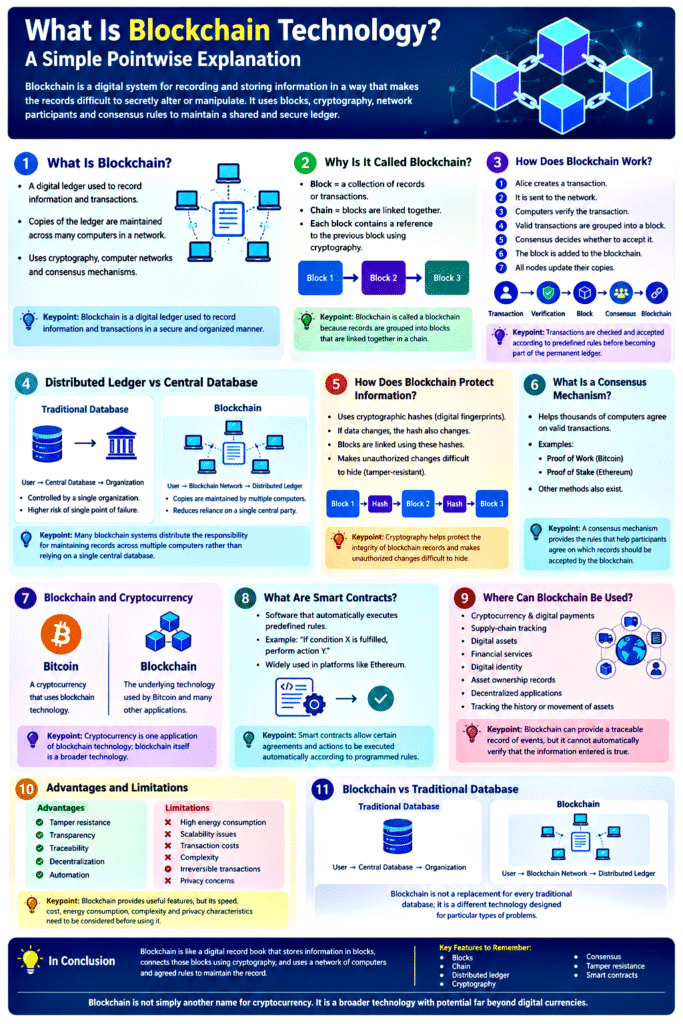
In simple words, blockchain is a digital system for recording and storing information in a way that makes the records difficult to secretly alter or manipulate.
Here are the important points to understand blockchain technology.
1. What Is Blockchain?
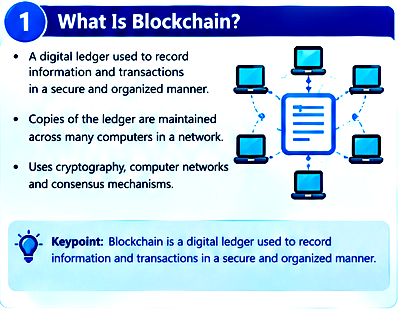
The easiest way to understand blockchain is to think of it as a digital record book or ledger.
Suppose a group of people needs to maintain a record of money transactions. Instead of keeping the record in one person’s notebook, they could maintain copies of the same record across many computers.
Whenever a new transaction is accepted, the record is updated according to the rules of the network.
Blockchain technology uses cryptography, computer networks and consensus mechanisms to maintain this shared record.
Keypoint: Blockchain is a digital ledger used to record information and transactions in a secure and organized manner.
2. Why Is It Called Blockchain?
The word blockchain is made up of two words:
Block + Chain
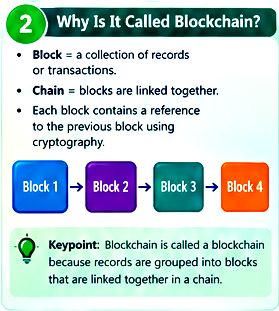
A block is a collection of records or transactions grouped together.
A chain means that these blocks are connected to one another.
For example:
Block 1 → Block 2 → Block 3 → Block 4 → Block 5
Each block contains information that connects it to the previous block. Cryptographic techniques help create these connections.
As new blocks are added, the chain continues to grow.
Keypoint: Blockchain is called a blockchain because records are grouped into blocks that are linked together in a chain.
3. How Does Blockchain Work?
Suppose Alice wants to send a digital asset to Bob.
The process can be simplified into the following steps:
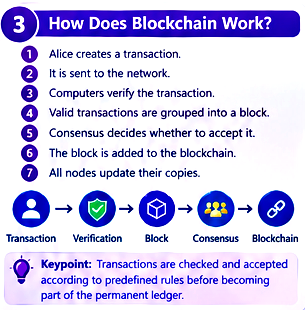
Step 1: Alice creates a transaction.
Step 2: The transaction is sent to the blockchain network.
Step 3: Participating computers check whether the transaction follows the network’s rules.
Step 4: Valid transactions are collected into a block.
Step 5: The blockchain’s consensus mechanism determines whether the block should be accepted.
Step 6: The accepted block is added to the existing blockchain.
Step 7: Participating computers update their copies of the ledger.
Therefore, the basic process can be shown as:
Transaction → Verification → Block → Consensus → Blockchain
Different blockchains use different technical methods, so the exact process is not identical everywhere.
Keypoint: Blockchain transactions are checked and accepted according to predefined rules before becoming part of the permanent ledger.
4. What Makes Blockchain Different from a Normal Database?
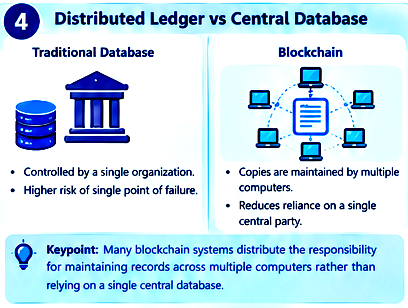
A traditional database is usually controlled by a particular organization.
For example, a bank maintains a database containing information about its customers and transactions.
Many blockchain networks work differently. Copies of the ledger can be maintained by numerous computers participating in the network.
This is known as a distributed ledger.
Imagine 1,000 people having copies of the same digital record book. When a new record is accepted, participating computers update their copies according to the network’s rules.
This reduces reliance on a single central record keeper in decentralized blockchain systems.
However, not every blockchain is completely decentralized. Some private or permissioned blockchains can be controlled by a particular organization or group.
Keypoint: Many blockchain systems distribute the responsibility for maintaining records across multiple computers rather than relying on a single central database.
5. How Does Blockchain Protect Information?
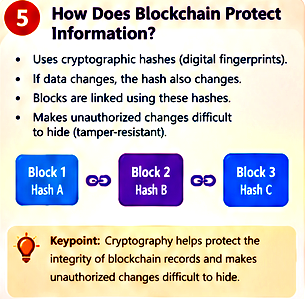
Blockchain uses cryptography to help protect the integrity of its records.
One important concept is a cryptographic hash. A hash can be thought of as a digital fingerprint of information.
If the information changes, its resulting hash also changes.
Blockchain systems use these cryptographic relationships to connect blocks.
For example:
Block 1 → Hash → Block 2 → Hash → Block 3
If someone attempts to secretly change information in an earlier block, the cryptographic relationships can reveal that something has been altered.
This is one reason blockchain is considered tamper-resistant.
However, blockchain should not be described as completely impossible to change. Different blockchain systems have different security properties.
Keypoint: Cryptography helps protect the integrity of blockchain records and makes unauthorised changes difficult to hide.
6. What Is a Consensus Mechanism?
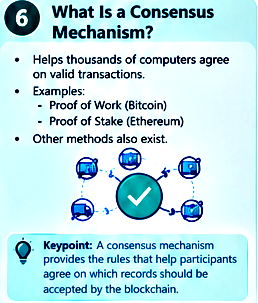
If thousands of computers are maintaining a shared ledger, they need a method for agreeing on which transactions are valid.
This is called a consensus mechanism.
Different blockchains use different consensus mechanisms.
Two well-known examples are:
Proof of Work
Computers perform computational work to help secure and validate the network. Bitcoin uses Proof of Work.
Proof of Stake
Participants commit cryptocurrency as a form of stake and take part in the network’s validation process. Ethereum currently uses Proof of Stake.
These are just two examples; blockchain networks can use other consensus designs as well.
Keypoint: A consensus mechanism provides the rules that help participants agree on which records should be accepted by the blockchain.
7. Blockchain and Cryptocurrency
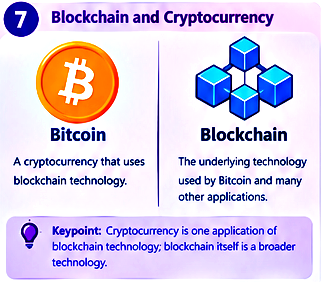
Blockchain became widely known because of Bitcoin.
Bitcoin is a cryptocurrency that uses blockchain technology to maintain its transaction history without relying on a conventional central authority to maintain the ledger.
But Bitcoin and blockchain are not the same thing.
Bitcoin is a digital currency.
Blockchain is the technology used by Bitcoin to maintain its transaction records.
Other cryptocurrencies can use their own blockchain networks or other types of distributed-ledger technology.
Keypoint: Cryptocurrency is one application of blockchain technology; blockchain itself is a broader technology.
8. What Are Smart Contracts?
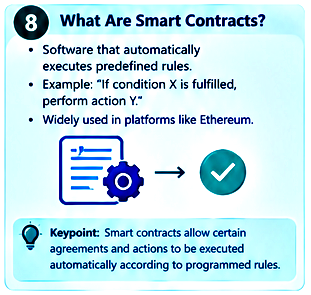
Some blockchain platforms support smart contracts.
A smart contract is software that automatically executes predefined rules.
For example, imagine a digital agreement that says:
“If condition X is fulfilled, perform action Y.”
When the required conditions are met, the software can automatically execute the programmed action.
Smart contracts are particularly associated with blockchain platforms such as Ethereum.
They are used to create various decentralized applications and digital services.
Keypoint: Smart contracts allow certain agreements and actions to be executed automatically according to programmed rules.
9. Where Can Blockchain Be Used?
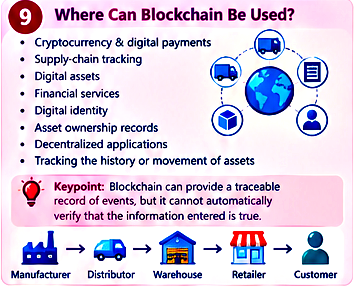
Blockchain is not limited to cryptocurrency.
Potential applications include:
- Cryptocurrency and digital payments
- Supply-chain tracking
- Digital assets
- Smart contracts
- Financial services
- Digital identity
- Asset ownership records
- Decentralized applications
- Tracking the history or movement of certain assets
For example, in a supply chain, information could potentially be recorded as a product moves from:
Manufacturer → Distributor → Warehouse → Retailer → Customer
This could create a traceable record of events.
However, blockchain does not automatically guarantee that the information entered into it is correct. If incorrect information is entered, blockchain technology may simply preserve that incorrect information.
Keypoint: Blockchain can provide a traceable record of events, but it cannot automatically verify that every piece of real-world information entered into the system is true.
10. Advantages and Limitations of Blockchain
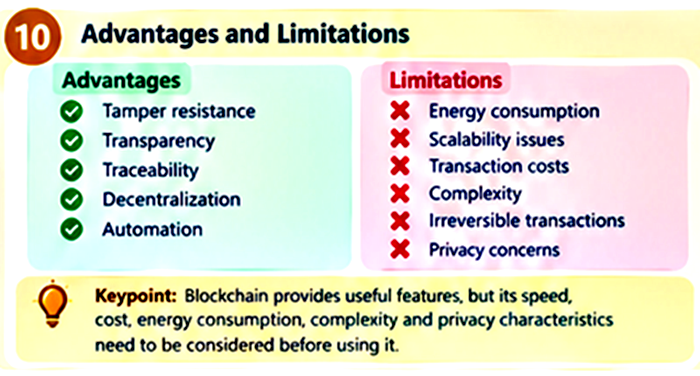
Blockchain has several potential advantages.
Advantages
Tamper resistance: Historical records can be difficult to alter.
Transparency: Many public blockchains allow transaction records to be inspected.
Traceability: Blockchain can maintain a history of transactions or recorded events.
Decentralisation: Some blockchain networks distribute control and record-keeping among many participants.
Automation: Smart contracts can automate certain processes.
At the same time, blockchain has limitations.
Energy consumption: Some blockchain systems, particularly Proof of Work networks, require substantial computing power.
Scalability: Some blockchains can have difficulty processing very large numbers of transactions quickly.
Transaction costs: Fees can increase when network demand is high.
Complexity: Blockchain systems can be difficult for ordinary users to understand.
Irreversible transactions: Some blockchain transactions can be difficult or impossible to reverse.
Privacy concerns: Public blockchain records may be visible to anyone, depending on the blockchain.
Keypoint: Blockchain provides useful features, but its speed, cost, energy consumption, complexity and privacy characteristics need to be considered before using it.
11. Blockchain vs Traditional Database
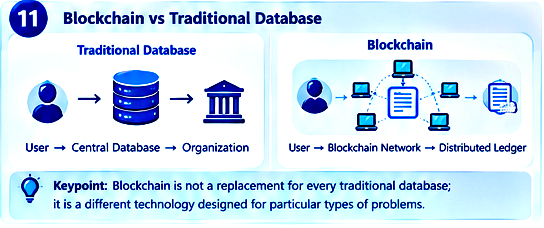
A simple comparison can help clarify the difference.
Traditional database
User → Central database → Organization
A particular organization generally controls the database.
Blockchain
User → Blockchain network → Distributed ledger
Multiple computers may maintain and validate the ledger, depending on the blockchain’s design.
This does not mean blockchain is always better than a traditional database.
For many applications, a conventional database can be faster, simpler and less expensive.
Blockchain becomes particularly interesting when multiple parties need to share a record and there is a reason to use cryptographic verification, distributed control or strong resistance to historical modification.
Keypoint: Blockchain is not a replacement for every traditional database; it is a different technology designed for particular types of problems.
Conclusion
Blockchain technology can be described as a digital record-keeping system that uses blocks, cryptography, network participants and consensus rules to maintain a shared history of information.
Its major features include:
🔹 Blocks: Records are grouped together.
🔹 Chain: Blocks are linked using cryptographic relationships.
🔹 Distributed ledger: Multiple computers may maintain copies of the records.
🔹 Cryptography: Mathematical techniques help protect the integrity of information.
🔹 Consensus: Network participants follow agreed rules to validate records.
🔹 Tamper resistance: Changing historical information can be difficult.
🔹 Smart contracts: Some blockchains can automatically execute programmed instructions.
The most important thing to remember is that blockchain is not simply another name for cryptocurrency. Cryptocurrency is one application of blockchain technology. The underlying technology can potentially be used for many other purposes where organisations or individuals need a shared, verifiable and tamper-resistant record.
In very simple words:
Blockchain is like a digital record book that stores information in blocks, connects those blocks using cryptography, and uses a network of computers and agreed rules to maintain the record.
This basic concept is the foundation for understanding technologies such as Bitcoin, Ethereum, smart contracts, digital assets and decentralised applications.