
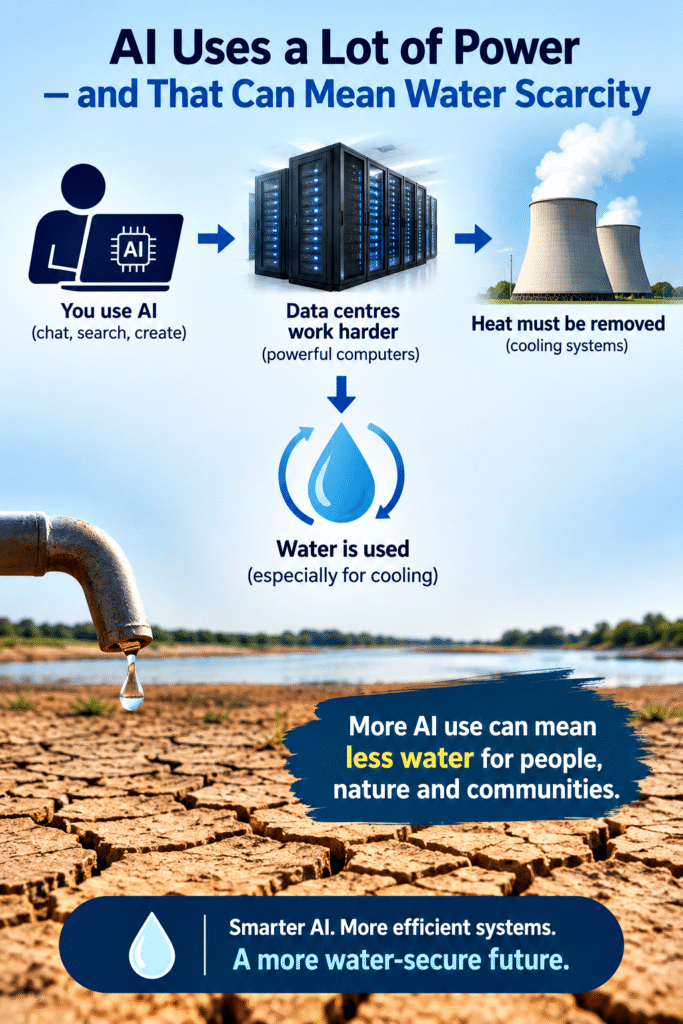
The Hidden Connection Between AI and Water Scarcity
Yes. AI can lead to significant water use, although the water is not being used by the AI software itself. The water is mainly associated with the data centres and electricity systems that power AI.
This is an important environmental issue because AI use is growing very rapidly, and some AI data centres require enormous amounts of computing power.
How does AI use water?
Think of an AI data centre as a huge building filled with extremely powerful computers, especially GPUs.
AI request → Powerful computers → Heat → Cooling → Water use
Here is what happens:
- AI computers consume electricity
- Training an AI model and answering AI queries require powerful processors.
- Almost all the electricity eventually becomes heat.
- The computers become extremely hot
- Modern AI servers can generate much more heat than ordinary computers.
- Data centres therefore need sophisticated cooling systems.
- Water can be used to remove that heat
- One common method uses cooling towers.
- Warm water is circulated and some of it evaporates, carrying heat away.
- Fresh water has to be added to replace the evaporated water. The U.S. Department of Energy explains that evaporation is a major source of water consumption in cooling-tower systems.
- There is also indirect water consumption
- AI requires electricity.
- Some power plants use water for cooling while generating that electricity.
- Therefore, even when a data centre itself uses relatively little water, its electricity supply can have a water footprint.
A 2025 Nature Sustainability study estimated that AI servers deployed across the United States could have an annual water footprint of 731–1,125 million cubic metres by 2030, depending on how rapidly they expand and where they are located. It estimated that about 29% was direct water use and 71% indirect in its modelling.
Why is this becoming a bigger issue?
The amount of computing required for AI is increasing rapidly.
The IEA estimates that global data-centre electricity consumption rose 17% in 2025, while electricity consumption from AI-focused data centres increased even faster. It projects total data-centre electricity consumption could roughly double from about 485 TWh in 2025 to 950 TWh in 2030.
So the concern isn’t that one ordinary AI question uses a huge amount of water. Rather, the concern is the enormous cumulative demand from billions of AI interactions and increasingly powerful AI systems.
What are the side effects?
1. Pressure on local water supplies
If a large data centre is built in an area that already has limited water, its cooling requirements can compete with households, agriculture and other industries.
This is particularly concerning in hot or water-stressed regions.
2. Groundwater depletion
If freshwater is repeatedly taken from rivers, reservoirs or groundwater for cooling, excessive demand can put additional pressure on local water resources.
3. Impact on agriculture
In water-scarce areas, additional industrial water demand can potentially compete with agricultural requirements.
4. Environmental impact
Water isn’t the only issue.
AI data centres also require large amounts of electricity. The IEA says a hyperscale AI-focused data centre can require 100 MW or more, comparable to the electricity consumption of around 100,000 households.
If that electricity comes from fossil fuels, it can also contribute to greenhouse-gas emissions.
5. Local impact can be much greater than global averages
This is an important point.
Globally, data centres currently represent a relatively small proportion of total electricity consumption. But data centres are geographically concentrated, so their local impact can be much larger than the global percentage suggests.
How can we solve or reduce the problem?
We don’t necessarily need to stop using AI. The better approach is to make AI computing much more water- and energy-efficient.
1. Use closed-loop cooling
Instead of continually consuming fresh water, data centres can use closed-loop systems, where the same water circulates repeatedly through the cooling system.
Modern facilities are increasingly using such approaches. The U.S. Department of Energy notes that closed-loop cooling can greatly reduce water consumption compared with continuously evaporative systems.
2. Use air cooling where practical
In suitable climates, outside air can help remove heat without consuming large quantities of water.
This is particularly attractive in cooler or dry climates, although it isn’t appropriate for every location or every high-density AI facility.
3. Use advanced liquid cooling
AI processors are becoming so powerful that conventional air cooling can become difficult.
Direct-to-chip liquid cooling can transfer heat efficiently and can potentially reduce both energy and water requirements when appropriately designed.
4. Build data centres in suitable locations
This may be one of the most important solutions.
Companies should consider:
- Availability of freshwater
- Local drought conditions
- Climate
- Renewable-energy availability
- Existing electricity infrastructure
- Availability of recycled/non-potable water
An AI data centre should not ideally be placed in an area already suffering from severe water shortages.
Research indicates that simply changing the geographical distribution of AI servers can have a very large effect on their water footprint.
5. Use recycled wastewater
Instead of using drinking-quality freshwater, data centres can potentially use:
treated wastewater → cooling system → heat removal
This allows valuable freshwater to be reserved for drinking, agriculture and ecosystems.
6. Make AI models more efficient
This is probably the most fundamental technological solution.
Developers can reduce the computing required for an AI task through:
- More efficient AI models
- Better chips
- Model compression
- Quantization
- Efficient algorithms
- Smaller models for simple tasks
- Better server utilization
The IEA reports that energy use per individual AI task has been falling very rapidly, although the growing number and complexity of AI applications can offset those efficiency gains.
7. Use renewable electricity
Solar, wind and other low-carbon electricity sources can reduce the carbon footprint associated with AI.
However, renewable energy does not automatically eliminate water consumption. The cooling system and the location of the data centre still matter.
8. Measure and publicly report water consumption
AI companies and data-centre operators should report metrics such as:
Water Usage Effectiveness (WUE)
WUE measures how much water is consumed in relation to the electricity used by IT equipment.
Greater transparency would allow governments and consumers to compare companies and data centres based on their environmental performance.
An important distinction
It is easy to hear statements such as:
“Every AI question uses a bottle of water.”
That is too simplistic.
The actual water footprint of an AI task depends on many factors:
AI model + type of task + data-centre efficiency + cooling technology + climate + location + electricity source + time of operation
A short text query and a very large AI video-generation task can have dramatically different computing requirements. The IEA notes that newer energy-intensive applications such as video generation and agentic AI can consume hundreds or even thousands of times more energy per query than simple text generation.
So the issue is real, but individual numbers should be treated carefully.
The bigger picture
I would describe the problem this way:
AI itself doesn’t “drink water.” AI creates enormous computing demand. That computing produces heat. Removing that heat can require water, while producing the electricity for the computing can also require water.
Therefore:
More AI → More computing → More electricity → More heat → More cooling → Potentially more water use
But there is another side:
Better chips + efficient AI + efficient cooling + recycled water + renewable energy + sensible data-centre locations → Much lower environmental impact.
And this is important because AI efficiency is improving rapidly. The goal shouldn’t necessarily be “stop AI because it uses water”. It should be “make the rapidly growing AI infrastructure dramatically more water-efficient.”
If you’re considering this as a topic for Technocolumns, it would actually make an excellent “Tech Simplified” article because the connection between AI → electricity → heat → cooling → water is something most ordinary users don’t realise.